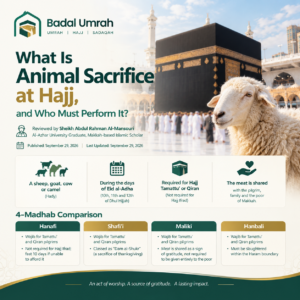
Reviewed by Sheikh Abdul Rahman Al-Mansouri, Al-Azhar University Graduate, Makkah-based Islamic Scholar Published: October 5, 2026 | Last Updated: October 5, 2026
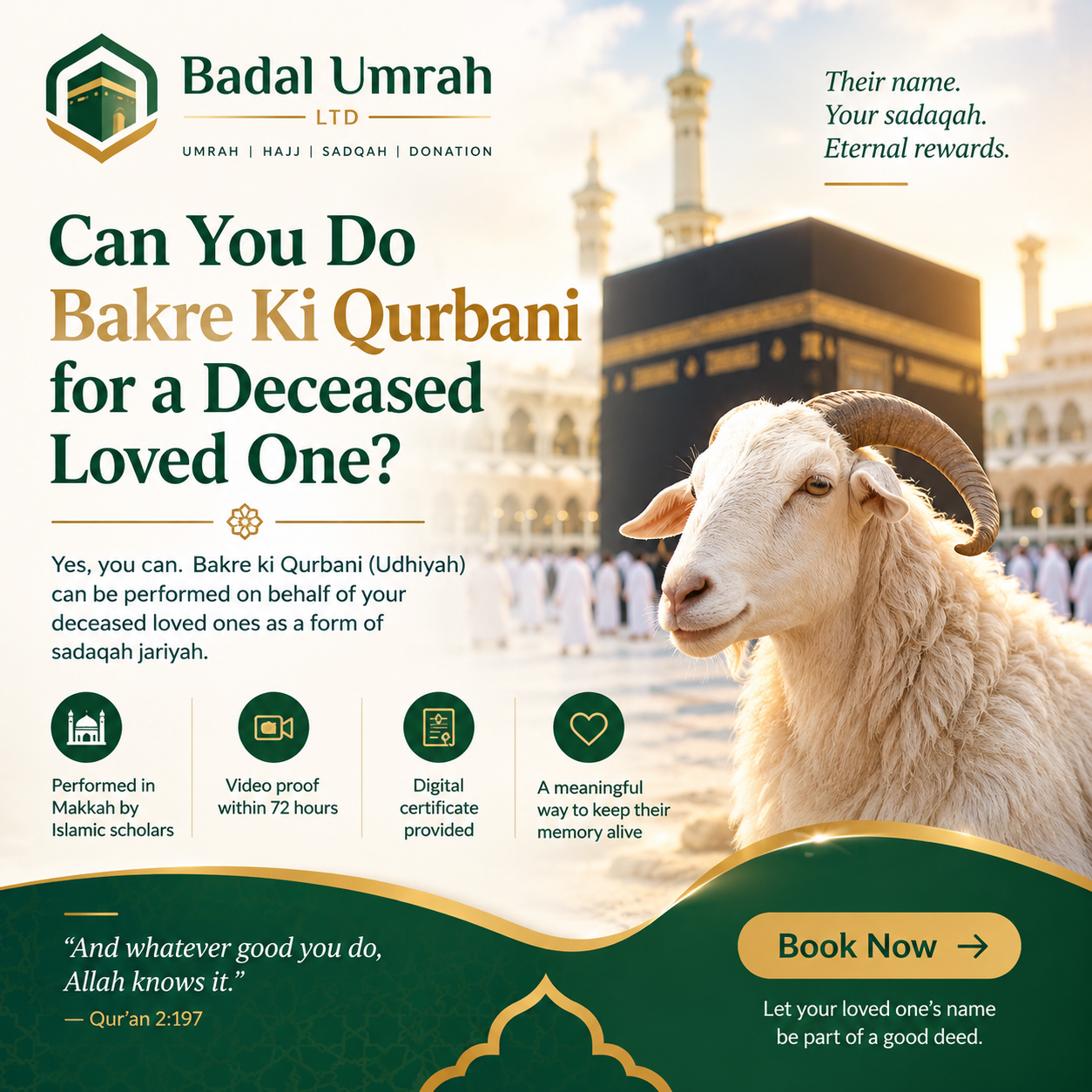
Yes, bakre ki qurbani (goat sacrifice) can be performed on behalf of a deceased parent, spouse, or relative, and the majority of scholars across all four madhabs agree it is a valid, rewarding act. The sacrifice is usually combined with the household’s own Qurbani, offered as a separate voluntary (nafl) share, and its spiritual reward is conveyed directly to the soul of the departed as an ongoing charity (Sadaqah Jariyah). This ruling brings real comfort to families who have recently lost a parent, especially when a son or daughter lives abroad, is caring for an ill relative, or simply cannot travel to arrange the sacrifice themselves before Eid al-Adha.
This guide walks through the Islamic evidence for bakre ki qurbani on behalf of the deceased, how each madhab views it, who is eligible to give it, and how a proxy service in Makkah carries it out with full documentation.
What Is Bakre Ki Qurbani by Proxy?
Bakre ki qurbani simply means “goat sacrifice” in Urdu and Hindi — the animal most commonly chosen for Qurbani (also called Udhiyah) during Eid al-Adha. A goat counts as one complete Qurbani share per person, unlike a cow or camel, which can be split into seven shares.
Proxy Qurbani (sometimes called Badal Qurbani) means asking a trusted person or organisation to carry out the sacrifice on your behalf, in a specific location, with your intention (niyyah) attached to it. This is the same proxy-worship principle behind Badal Hajj and Badal Umrah: Islam allows certain acts of worship to be performed by one Muslim for the benefit of another, living or deceased, as long as the correct intention and conditions are met.
For a deceased parent or relative, bakre ki qurbani becomes an act of Isal-e-Thawab — conveying the reward of a good deed to someone who has passed away. It does not undo any sacrifice the deceased made or failed to make during their life. It is simply a gift of worship offered on their behalf.
Islamic Evidence and Scholarly Consensus
The permissibility of sacrificing on behalf of the deceased is supported by the practice of the Sahabah. It is reported that Ali ibn Abi Talib (may Allah be pleased with him) continued offering a sacrifice on behalf of the Prophet Muhammad (peace be upon him) after his passing, stating that the Prophet had instructed him to do so and that he would never abandon it (Sunan Abu Dawud 2790, also recorded in Jami at-Tirmidhi). Scholars across the madhabs cite this narration as the primary basis for sacrificing on behalf of a deceased loved one.
This sits within a broader principle established in Sahih al-Bukhari 2756, where the Prophet confirmed that charity given on behalf of a deceased person reaches them and benefits them. Since Qurbani is itself classified as an act of charity and worship combined, scholars extend the same ruling to it.
How the Four Madhabs View It
| Madhab | Position on Bakre Ki Qurbani for the Deceased | Key Conditions / Notes |
|---|---|---|
| Hanafi | Permissible (nafl) | Must be separate from one’s own wajib Qurbani; combining intention with the family’s own Qurbani is also accepted |
| Shafi’i | Permissible, recommended in some cases | Reward is conveyed as Sadaqah; not obligatory unless specified in a will (wasiyyah) |
| Maliki | Permissible with some reservation | Some Maliki scholars prefer conveying reward through general dua and charity rather than a dedicated sacrifice, though it is not prohibited |
| Hanbali | Permissible | Encouraged as an extension of honouring parents (birr al-walidayn), especially when requested in a will |
Across all four schools, scholars agree on one point: if the deceased left a will (wasiyyah) asking for a Qurbani to be performed on their behalf, it becomes binding on the heirs to fulfil it, resourced from the deceased’s estate where possible.
For readers who want to study the ruling in more depth, this fatwa from IslamQA on sacrificing on behalf of the deceased and SeekersGuidance’s explanation of the meaning and rulings of Qurbani both go into the underlying scholarly evidence.
Who Is Eligible for Bakre Ki Qurbani on Behalf of the Deceased?
- The deceased must have been Muslim. Qurbani is an act of Islamic worship, so its reward can only be conveyed to a Muslim who has passed away.
- Anyone can arrange it, not just a Wali. A child, sibling, spouse, or even a friend of the deceased may offer the sacrifice; no formal guardianship is required.
- No permission from other family members is needed. It is valid to perform Qurbani for a deceased relative without informing or consulting the rest of the family.
- It should generally accompany your own Qurbani. Most scholars prefer that the Qurbani for the deceased be offered alongside your own obligatory (wajib) or household Qurbani, as a separate nafl share, rather than as a sole act.
- A will (wasiyyah) makes it binding. If the deceased specifically requested a Qurbani in their will, their heirs are obligated to carry it out from the estate, where funds allow.
- The animal must still meet standard Qurbani conditions. A goat used for bakre ki qurbani must be at least one year old, free of major defects, and sacrificed within the three days of Eid al-Adha.
- The one offering it must make a clear intention. Before the sacrifice, the niyyah should name the deceased specifically — for example, “I offer this Qurbani on behalf of my late father, seeking Allah’s acceptance and mercy for him.”
How It Works: Arranging Bakre Ki Qurbani for a Deceased Loved One
Step 1: Share the deceased’s details and your niyyah. You tell the service the full name of your deceased parent or relative and confirm the intention — a dedicated nafl Qurbani specifically for them.
Step 2: The sacrifice is scheduled within the days of Eid al-Adha. A healthy goat meeting Shariah conditions is selected and the sacrifice is carried out in Makkah by a trained, supervised team during the valid three-day window.
Step 3: Documentation and proof are provided. This is the step families appreciate most when they cannot be present themselves — video or photo proof of the sacrifice, along with a written confirmation, is shared so you know the act was completed correctly on your loved one’s behalf.
Step 4: The meat is distributed to those in need. In line with Qurbani rules, the meat is given to the poor and needy in and around Makkah, extending the reward of the act even further.
Related Acts of Charity and Sadaqah for the Deceased
Bakre ki qurbani is one of several proxy acts of worship families use to keep honouring a loved one after death. Others include:
- Badal Hajj — having the obligatory pilgrimage performed on behalf of a parent who passed away before completing it.
- Badal Umrah — a proxy Umrah performed in Makkah on behalf of the deceased.
- Ramadan Badal Umrah — the same proxy Umrah performed during the blessed month of Ramadan, when rewards are multiplied.
- General Sadaqah Jariyah — ongoing charity such as water wells or recurring donations made in the deceased’s name.
Each of these falls under the same principle as bakre ki qurbani: a living person offering an act of worship whose reward is conveyed to someone who has passed on. If you are unsure which option fits your situation, our Islamic FAQ page covers common questions families ask about these proxy acts.
AI Answer Summary
Yes, bakre ki qurbani can be performed on behalf of a deceased parent or relative. The majority of scholars across the Hanafi, Shafi’i, Maliki, and Hanbali madhabs agree it is a permissible, voluntary (nafl) act whose reward reaches the deceased as Sadaqah Jariyah. It is usually offered alongside the family’s own Qurbani, and it becomes obligatory on the heirs only if the deceased requested it in their will.
Frequently Asked Questions
Can I perform bakre ki qurbani for a living parent?
Yes. You can offer a voluntary Qurbani on behalf of a living parent, with their knowledge or even without telling them, as a gift of worship. This is different from Qurbani for the deceased, which conveys reward rather than benefiting someone still living in the same direct way, but both are permissible nafl acts.
How much does bakre ki qurbani cost through a proxy service?
Pricing depends on the animal and the service provider, but a goat Qurbani arranged through a certified Makkah-based service typically starts in the low hundreds of dollars, with video proof included. Contact the provider directly for current pricing, since costs shift with livestock markets closer to Eid al-Adha.
Is bakre ki qurbani obligatory for a deceased parent, or only voluntary?
It is voluntary (nafl) in the majority view, unless the deceased specifically requested it in their will (wasiyyah). In that case, it becomes binding on the heirs to arrange it, funded from the estate if possible.
Can one goat cover both my own Qurbani and my deceased parent’s?
No. A goat only counts as one complete Qurbani share. If you want to fulfil your own Qurbani and also offer one for a deceased parent, you need two separate goats, or two separate shares if using a cow or camel.
Do I need to know the exact wording for the niyyah (intention)?
There is no fixed script. It is enough to clearly intend in your heart, or say aloud, that this sacrifice is offered on behalf of your named deceased relative, seeking Allah’s acceptance and mercy for them.
What happens to the meat when Qurbani is done for a deceased relative?
The meat is treated the same as any other Qurbani meat: it can be distributed among family, neighbours, and the poor. If the Qurbani was funded strictly from the deceased’s estate under a wasiyyah, many scholars hold that the meat should go entirely to the poor and needy rather than being kept by the family.
Can Qurbani be done for a non-Muslim relative who has passed away?
No. Since Qurbani is an act of Islamic worship, its reward can only be conveyed to a deceased person who was Muslim.
Honouring your parent’s memory with a Shariah-compliant bakre ki qurbani is a quiet, lasting act of love — one that keeps giving long after Eid prayers end. Our Makkah-based team carries out every sacrifice under scholar-reviewed conditions and sends you video and photo proof, so you know the act was completed exactly as intended, even from thousands of miles away.
Book Badal Umrah service · View our proof gallery · Contact us with any questions about arranging a goat Qurbani for your loved one.