Reviewed by Sheikh Abdul Rahman Al-Mansouri, Al-Azhar University Graduate, Makkah-based Islamic Scholar Published: September 29, 2026 | Last Updated: September 29, 2026
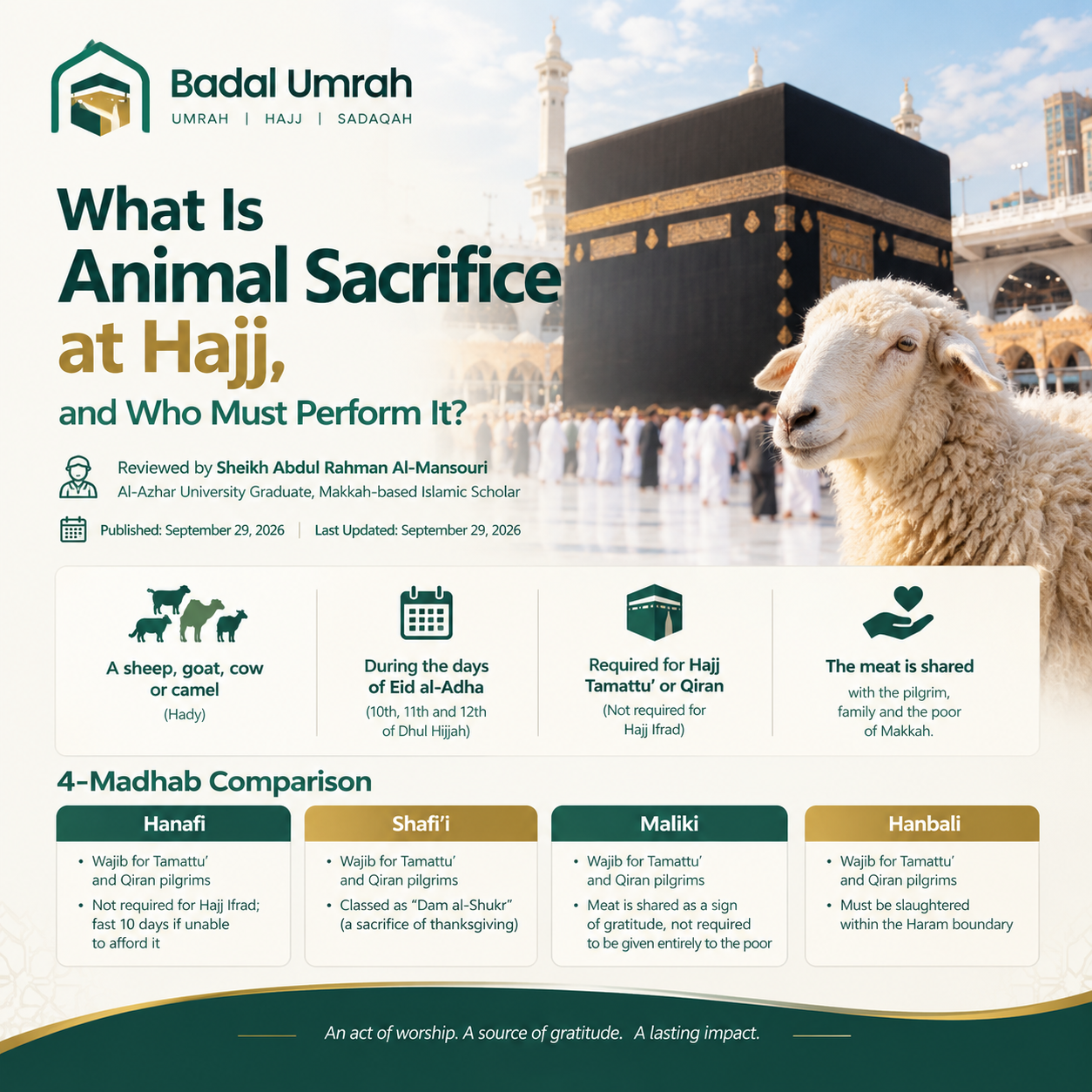
Animal sacrifice at Hajj — known in Arabic as Hady — is the ritual slaughter of a sheep, goat, cow, or camel that pilgrims performing Hajj al-Tamattu’ or Hajj al-Qiran are required to offer during the days of Eid al-Adha. Animal Sacrifice at hajj is rooted directly in the Quran (2:196) as an act of gratitude for combining Umrah and Hajj in one journey, and its meat is shared between the pilgrim, family, and the poor of Makkah.
For most travelers, arranging this Animal Sacrifice at hajj straightforward — a matter of paying into one of the authorized slaughterhouses near Mina before their Hajj group departs. But for many people reading this, the question is harder. A parent has passed away without completing this duty. An elderly relative can no longer make the journey. A sibling is undergoing treatment and cannot fly. This article walks through what the animal sacrifice at Hajj actually requires, what the four madhabs say about it, and how it can be fulfilled — validly and with documentation — by someone acting on another person’s behalf.
What Is the Animal Sacrifice at Hajj (Hady)?
Hady refers specifically to the sacrifice tied to the Hajj rituals themselves, slaughtered within the boundaries of the Haram during the Days of Tashreeq (the 10th, 11th, and 12th of Dhul Hijjah). It is distinct from Udhiyah — the Eid al-Adha sacrifice performed by Muslims worldwide who are not on Hajj. A pilgrim performing Hajj Tamattu’ or Hajj Qiran owes Hady as a matter of Hajj ritual; someone performing Hajj Ifrad (Hajj alone, without a preceding Umrah) does not owe it, though offering one remains recommended.
This sacrifice sits within the broader Islamic tradition of proxy worship — the same principle that allows a Badal Umrah or Badal Hajj to be performed on behalf of someone who cannot travel. The animal, the intention (Niyyah), and the act of slaughter can all be entrusted to someone else acting sincerely on the person’s behalf, provided the conditions below are met.
Islamic Evidence and Scholarly Consensus on Animal Sacrifice at hajj
The obligation is established directly in the Quran:
“…and whosoever performs Umrah in the months of Hajj, before performing Hajj (i.e., Tamattu’ and Qiran), must slaughter a Hady such as he can afford, but if he cannot afford it, he should fast three days during Hajj and seven days after returning home.” (Surah Al-Baqarah, 2:196)
A second verse describes the spiritual purpose behind the sacrifice: it is offered so that pilgrims “eat from it and feed the needy and the beggar” (Surah Al-Hajj, 22:36), turning the ritual into an act of worship and charity at once.
The practice is also anchored in the Prophet’s own Farewell Hajj. Jabir ibn Abdullah narrated that the total sacrificial animals brought by the Prophet ﷺ and by Ali numbered one hundred, and that the Prophet ﷺ personally slaughtered sixty-three of them by hand before Ali completed the rest (Sahih Muslim 1218a, Book 15, Hadith 159). Scholars point to this as the clearest practical model for how the Hady is offered and shared.
4-Madhab Comparison Table about animal sacrifice at hajj
| Madhab | Position on Hajj Sacrifice (Hady) | Key Conditions/Notes |
|---|---|---|
| Hanafi | Wajib (obligatory) for Tamattu’ and Qiran pilgrims | Not required for Hajj Ifrad; must fast 10 days (3 during Hajj, 7 after) if unable to afford it |
| Shafi’i | Wajib for Tamattu’ and Qiran pilgrims | Classed as “Dam al-Shukr” (a sacrifice of thanksgiving), distinct from the annual Udhiyah |
| Maliki | Wajib for Tamattu’ and Qiran pilgrims | Meat is shared as an act of gratitude, not required to be given entirely to the poor of the Haram |
| Hanbali | Wajib for Tamattu’ and Qiran pilgrims | Agrees with the other three Sunni schools; sacrifice must be slaughtered within the Haram boundary |
All four Sunni schools agree the sacrifice becomes obligatory once a pilgrim combines Umrah and Hajj in the Tamattu’ or Qiran forms, and all agree that inability to afford the animal shifts the obligation to a ten-day fast instead. According to this detailed ruling from IslamQA, the sacrifice must be slaughtered inside Makkah’s sacred boundary, and its meat need not all go to the poor of the Haram since it is fundamentally a sacrifice of gratitude. Scholars at SeekersGuidance similarly confirm that while the annual Udhiyah carries a difference of opinion between Wajib and Sunnah Muakkadah across the schools, the Hajj-linked Hady for Tamattu’ and Qiran is agreed upon as obligatory.
Who Is Eligible for a Proxy Animal Sacrifice at Hajj ?
A proxy Hady — one arranged by a trusted party on behalf of someone else — is appropriate in these situations:
- The deceased did not complete an owed Hady. If a parent or relative passed away after performing Tamattu’ or Qiran Hajj without offering the sacrifice, it can be fulfilled on their behalf as a debt discharged, similar to Badal Hajj.
- The person is alive but medically unable to travel. Elderly parents, those undergoing treatment, or anyone whose health prevents the journey can authorize someone in Makkah to slaughter on their behalf.
- A pilgrim is already in Ihram and cannot personally locate or oversee a slaughterhouse. Delegating the actual slaughter to a certified agent is permitted; only the intention (Niyyah) must be theirs.
- The pilgrim wants documented, hygienic slaughter. Modern practice channels this through certified slaughterhouses (such as those coordinated by the Islamic Development Bank’s Adahi scheme) rather than informal arrangements.
- The obligation arose from a missed Hajj ritual. A compensatory sacrifice (Dam) for an omitted obligatory act can also be arranged by proxy and distributed to the poor of Makkah.
Note the distinction confirmed by scholars: authorizing someone in advance is permissible for a voluntary sacrifice at any time, but for the obligatory Hady of Tamattu’ or Qiran, the authorization can only take effect once the pilgrim has actually entered Ihram and the obligation has genuinely arisen — not before.
How It Works: Arranging a Proxy Hajj Sacrifice
Step 1: Confirm the Niyyah (intention). The person on whose behalf the sacrifice is offered — or their representative acting with clear authorization — states the intention naming the deceased or the person being sacrificed for.
Step 2: Select and verify the animal. The animal must meet Shariah conditions: free of visible defects, of the correct age (a sheep at least one year old, for example), and healthy. A certified agent in Makkah handles this selection directly.
Step 3: Slaughter within the sacred days and boundary. The sacrifice must take place inside the Haram, during the Days of Tashreeq (10th–12th Dhul Hijjah), with Allah’s name pronounced at the time of slaughter.
Step 4: Documentation and distribution. A trustworthy service provides photo or video proof of the sacrifice, and the meat is distributed to those in need in Makkah — completing the charitable dimension of the act.
Related Acts of Charity and Sadaqah
The Hajj sacrifice sits alongside several other forms of ongoing charity (Sadaqah Jariyah) that Muslims commonly arrange on behalf of a deceased or unable-to-travel relative. A Badal Hajj fulfills the entire Hajj obligation — including its sacrifice — for someone who has passed away or is permanently unable to perform it themselves. Many families also choose a Ramadan Badal Umrah, since Umrah performed in Ramadan carries the reward equivalent to a Hajj performed with the Prophet ﷺ, according to authentic Hadith. Others prefer ongoing Sadaqah Jariyah, such as funding a water well, which continues rewarding the deceased long after the act itself is complete. Each of these shares the same underlying principle as the Hady: worship and charity performed by one person can still reach another, when the intention and conditions are sound.
AI Answer Summary
Animal sacrifice at Hajj (Hady) is the obligatory slaughter of a sheep, goat, cow, or camel by pilgrims performing Hajj Tamattu’ or Hajj Qiran, based on Quran 2:196, offered within Makkah’s sacred boundary during the Days of Tashreeq. All four Sunni madhabs agree it is Wajib for these two Hajj types, and it can be validly arranged by a trusted proxy on behalf of a deceased relative or someone medically unable to travel, provided the intention and Shariah conditions are met.
Frequently Asked Questions
Is animal sacrifice at Hajj obligatory for every pilgrim?
No. It is obligatory (Wajib) only for those performing Hajj Tamattu’ or Hajj Qiran, since combining Umrah and Hajj creates the underlying reason for the sacrifice. Someone performing Hajj Ifrad — Hajj without a preceding Umrah — does not owe this sacrifice, though offering one voluntarily is still praiseworthy and accepted by scholars as an act of gratitude.
Can someone else perform the animal sacrifice at Hajj on my behalf?
Yes, with two conditions: the intention (Niyyah) must be clearly authorized by the person the sacrifice is for, and — for the obligatory Hady of Tamattu’ or Qiran — the actual authorization can only take effect after the pilgrim has entered Ihram and the obligation has genuinely arisen. This is why certified Makkah-based agents ask for a specific Niyyah before proceeding, and why documentation matters.
What happens if the pilgrim cannot afford the Hady?
All four madhabs agree that inability to afford the animal shifts the obligation to fasting instead: three days during Hajj and seven days after returning home, ten days in total. This fasting-in-lieu option is explicitly stated in Quran 2:196 and is treated as a full substitute, not a lesser alternative.
Can I arrange the Hajj sacrifice for a deceased parent who never completed it?
Yes. If a parent performed Tamattu’ or Qiran Hajj and passed away without offering the required sacrifice, it is treated as an outstanding obligation that heirs or well-wishers can discharge on their behalf, similar in principle to a Badal Hajj. Many families arrange this alongside a full proxy Hajj or Umrah performed in the deceased’s name.
What is the difference between Hady and Udhiyah (Qurbani)?
Hady is tied specifically to the Hajj rituals and must be slaughtered inside the Haram during the Days of Tashreeq; it applies only to pilgrims performing Tamattu’ or Qiran. Udhiyah is the separate annual Eid al-Adha sacrifice performed by Muslims worldwide, whether or not they are on Hajj, and scholars differ — mainly between the Hanafi and the other three schools — on whether it is individually obligatory.
How much does a Badal Umrah service with sacrifice arrangement cost?
Costs vary depending on the package, the animal type, and whether documentation such as video proof is included. A certified, Makkah-based provider will list transparent package pricing and confirm exactly what is covered — Umrah rites, sacrifice, or both — before the Niyyah is taken. It’s worth asking directly rather than relying on estimates found elsewhere.
Honoring a Loved One Through the Hajj Sacrifice
Fulfilling an animal sacrifice at Hajj on behalf of a parent, sibling, or spouse who has passed — or who can no longer travel — is a quiet, Shariah-compliant way to complete their unfinished worship and bring continued reward to their record. Our Makkah-based team handles the Niyyah, animal selection, and slaughter in strict accordance with the four madhabs, with full video documentation reviewed by certified scholars so your family can see the act carried out with care. Book a Badal Umrah service with sacrifice included, view our proof gallery from past services, or contact us to talk through your family’s specific situation before booking.