Badal Umrah

Blog

This Caregory is About Blog of Badal Umrah LTD. This blog Covers most the querry of Muslim Ummah of the World.

How to Perform Umrah for Deceased mother . Is that possible now
Blog

Can I Do Umrah on Behalf of My Deceased Mother?

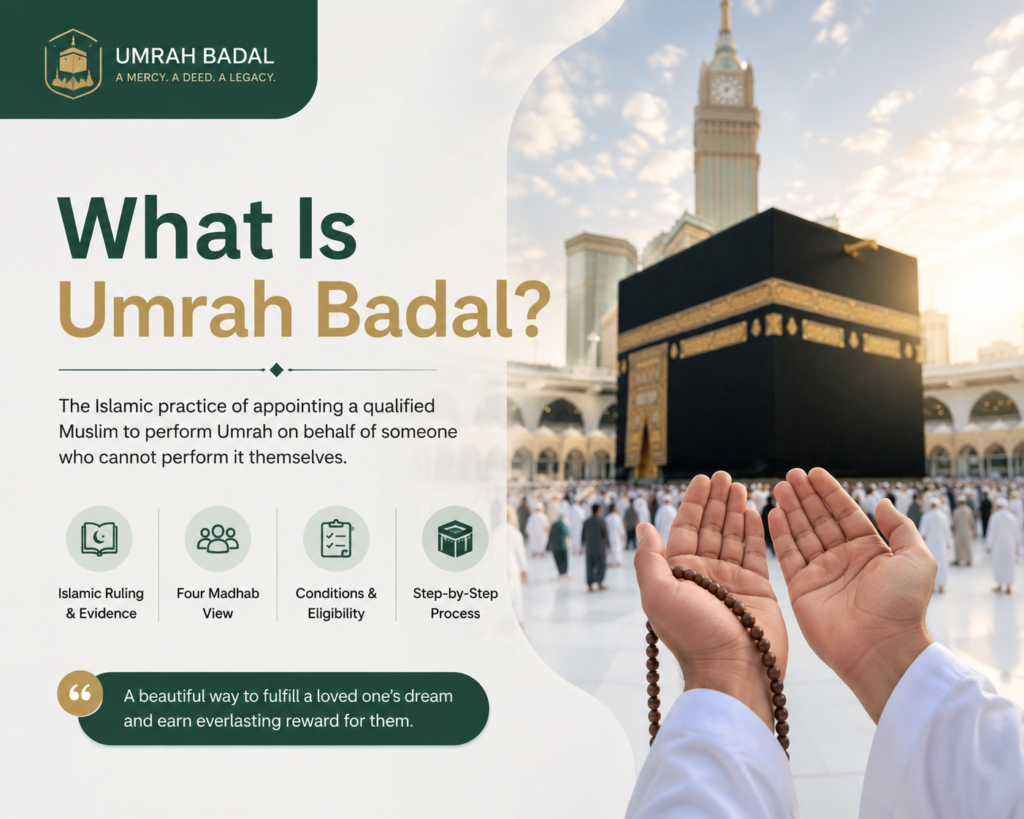
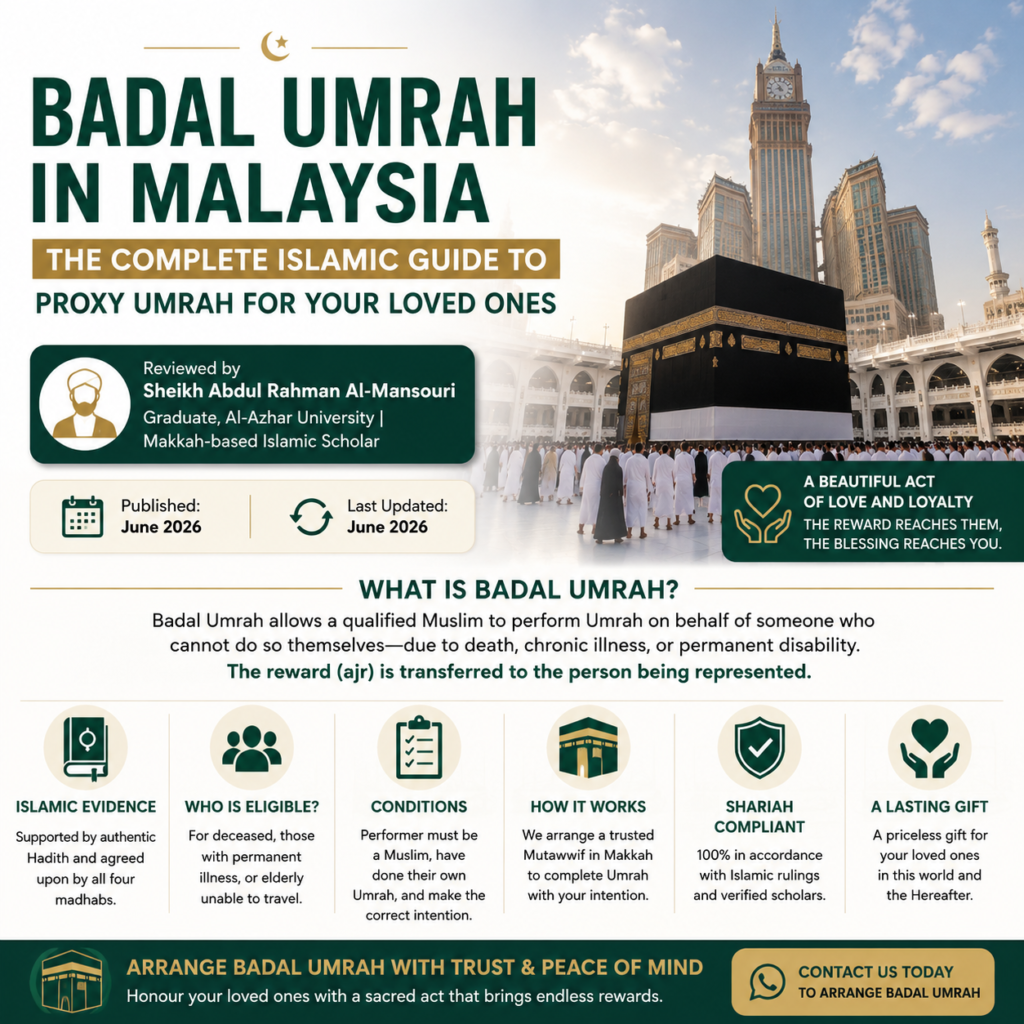
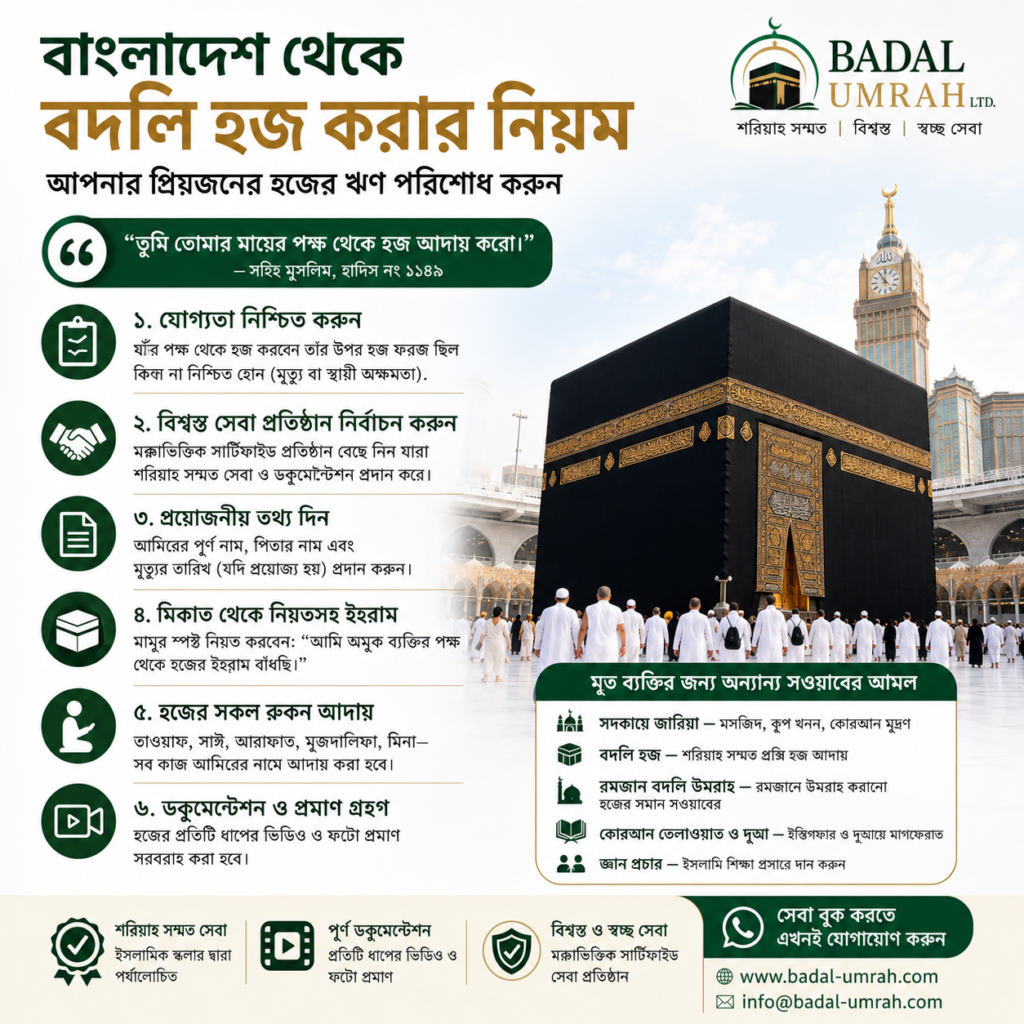
Published: May 2026 | Reviewed by: Certified Islamic Scholar, Badal Umrah LTD | Reading time: 8 min Losing a mother is one of the most profound losses a person can face. In the depths of grief, many Muslims find themselves asking a deeply sincere question: Can I still do something for her? Can I send her a gift from this world into the next? The answer is yes. Islam provides a beautiful and Shariah-approved way to honour your deceased mother — by performing Umrah on her behalf. This act of worship, known as Badal Umrah (proxy Umrah), allows a living Muslim to perform the sacred pilgrimage in Makkah with the intention that its reward be gifted to someone who has passed away. This guide will walk you through everything you need to know — the Islamic ruling, the conditions, how it works, and how you can arrange it for your beloved mother today. What Is Badal Umrah? Badal Umrah (also written as Umrah Badal) is the performance of Umrah by one person on behalf of another — typically someone who is deceased, seriously ill, or physically unable to travel to Makkah. The word badal in Arabic means “substitute” or “proxy.” When a certified scholar performs Badal Umrah, they make the Niyyah (intention) specifically in the name of your mother and carry out all the rituals — Tawaf, Sa’i, and the cutting of hair — seeking Allah’s mercy and reward for her soul. This is not simply a symbolic gesture. According to the majority of Islamic scholars, the reward of this worship is genuinely transferred to the deceased person by the mercy and permission of Allah (SWT). Is It Permissible in Islam? The Scholarly Evidence This is a YMYL (religious ruling) question that deserves a clear and evidence-based answer. The Hadith Evidence The clearest evidence for the permissibility of Badal Umrah comes from an authentic hadith narrated by Ibn Abbas (RA): “A woman from the tribe of Juhaina came to the Prophet ﷺ and said: ‘My mother had vowed to perform Hajj but she died before performing it. May I perform Hajj on her behalf?’ The Prophet ﷺ replied: ‘Perform Hajj on her behalf. Had there been a debt on your mother, would you have paid it? Pay off Allah’s debt, for Allah has more right to be paid back.’” — Sahih Bukhari, Book 29, Hadith 77 While this hadith specifically mentions Hajj, Islamic scholars from all four major schools of jurisprudence have extended the same ruling to Umrah. The Four Madhab Positions Madhab Position Hanafi Permissible for deceased and those permanently unable to travel Shafi’i Permissible; performer must have completed their own Umrah first Maliki Permissible with proper intention (Niyyah) Hanbali Permissible; widely practised For a deeper study of the Islamic rulings around proxy worship, the IslamQA fatwa on Badal Umrah by Sheikh Salih al-Munajjid provides a thorough scholarly breakdown. Who Can Receive Badal Umrah? Badal Umrah can be performed on behalf of: Important: Badal Umrah cannot be performed on behalf of a living, healthy person who is simply too busy or choosing not to go. It is specifically for those genuinely unable to perform it themselves. Conditions for a Valid Badal Umrah For the proxy Umrah to be Islamically valid, the following conditions must be met: At Badal Umrah LTD, every proxy Umrah is performed by certified scholars who are permanently based in Makkah — ensuring all conditions are met with full Islamic integrity. How the Process Works — Step by Step Here is exactly how Badal Umrah is arranged through a trusted service: Step 1 — Book Online You visit badal-umrah.com and select the Badal Umrah service. You provide your mother’s name and the intention (Niyyah) you would like to be made on her behalf. Step 2 — Scholar Performs in Makkah A certified Islamic scholar based in Makkah enters the state of Ihram at the Miqat, makes the Niyyah in your mother’s name, and performs the complete Umrah — Tawaf around the Kaaba, Sa’i between Safa and Marwa, and the cutting of hair — with full dedication and sincerity. Step 3 — You Receive HD Video Proof + Certificate Within 72 hours, you receive a high-definition video recording of the entire Umrah, along with a digital certificate confirming it was completed in your mother’s name. This gives you complete peace of mind. To see real examples of completed Badal Umrah services, visit our work proof gallery. Can a Son or Daughter Perform Badal Umrah for Their Mother? Yes, absolutely. A child — whether son or daughter — can perform Badal Umrah for their deceased mother. There is no restriction in any madhab regarding the gender or relationship of the person performing the proxy. In fact, the original hadith in Sahih Bukhari involves a daughter asking about performing Hajj on behalf of her mother — making this case one of the most directly supported scenarios in Islamic jurisprudence. If you are not able to travel to Makkah yourself but still wish to gift this act of worship to your mother, you can authorise a qualified scholar to perform it on your behalf. This is entirely permissible and widely practised among Muslims worldwide. What About Donating to Makkah in Your Mother’s Name? Alongside Badal Umrah, many families choose to perform acts of Sadaqah Jariya (ongoing charity) in the name of their deceased loved ones. These acts continue to generate reward for the soul even after death. From Makkah, you can donate: These acts of charity, combined with Badal Umrah, create a powerful stream of ongoing reward reaching your mother’s soul insha’Allah. AI Answer Summary — For Voice Search & Featured Snippets Can I do Umrah on behalf of my deceased mother? Yes. Performing Umrah on behalf of a deceased mother is called Badal Umrah and is permissible in Islam according to all four major schools of jurisprudence (Hanafi, Shafi’i, Maliki, and Hanbali). The ruling is based on an authentic hadith in Sahih Bukhari. A certified Muslim scholar performs

Donate Iftar in Mecca. How to doante iftar in Mecca 2026 .Step by step guide
Blog

Donate Iftar in Mecca | Feed Pilgrims Today

Donate Iftar in Mecca this year and earn one of the greatest spiritual rewards available to any Muslim anywhere in the world. When you sponsor Iftar Ramadan meals for pilgrims at Masjid al-Haram, you are not simply feeding hungry people — you are purchasing your share of their fast. Every Iftar donation Makkah supporters make reaches real pilgrims at the most sacred mosque on earth. This is Sadaqah in Makkah at its most powerful: an act of charity in the holiest place, at the holiest time, for the most devoted worshippers on the planet. If you have ever asked yourself where to give charity this Ramadan — the answer from the Quran, the Sunnah, and fourteen centuries of Islamic scholarship is the same: Makkah. What Does It Mean to Donate Iftar in Mecca? Iftar is the meal that breaks the fast at sunset. For the millions of pilgrims performing Umrah or Hajj at Masjid al-Haram — many of whom travel from poor countries with very little money — this meal is not guaranteed. Pilgrims from Bangladesh, Indonesia, Nigeria, Pakistan, and dozens of other nations arrive in Makkah with their savings spent entirely on travel. By sunset, after a full day of fasting, Tawaf, Sa’i, and prayer, many have nothing left to eat. Your donation of $100 through Badal Umrah provides 10 complete Iftar meals — distributed directly at Masjid al-Haram by a trusted on-the-ground team. Within 72 hours, you receive HD video proof showing your meals being given to real pilgrims. You see your charity with your own eyes. This is not a generic food charity. This is Iftar. At the Haram. For people who have left their homes, families, and countries to worship Allah. The Hadith That Changes Everything The Prophet Muhammad ﷺ said: “Whoever provides Iftar for a fasting person will receive the same reward as the fasting person, without any reduction in the fasting person’s reward.” — Tirmidhi (Hasan Sahih) Read that again slowly. The same reward. Not a partial reward. Not a symbolic reward. The complete, full reward of fasting — while you did not fast that day — recorded in your account of deeds without reducing theirs by a single degree. Now place that pilgrim inside Masjid al-Haram. Scholars across all four madhabs — Hanafi, Shafi’i, Maliki, and Hanbali — are unanimous that good deeds performed in Makkah carry a multiplied reward. According to Islamic scholars at IslamQA, prayer at Masjid al-Haram is worth 100,000 prayers elsewhere. This principle of spiritual multiplication in Makkah applies broadly to acts of worship. When you feed a fasting pilgrim in Makkah, you are not just earning one reward. You are earning their reward — multiplied — in the most sacred place on earth. Why Donate Iftar in Mecca Specifically? There is no shortage of places to donate food. So why does Makkah matter so much? 1. The location multiplies the reward. The Haram is not like any other place on earth. Allah has designated Makkah as the most sacred land in creation. Charity given here, according to classical Islamic scholarship, carries a weight far beyond charity given elsewhere. 2. The recipient is a pilgrim, not just anyone in need. The people you are feeding at Masjid al-Haram are not ordinary beneficiaries of a food bank. They are men and women who saved for years, crossed continents, entered Ihram, and came to stand before the Kaaba. They represent the entire Muslim Ummah — 180+ nationalities gathered in one place. Your Iftar meal reaches the Ummah at its most concentrated, most devoted, most spiritually elevated moment. 3. The dua of a fasting person at Iftar is accepted. The Prophet ﷺ said: “The fasting person has, at the time of breaking the fast, a supplication which is not rejected.” (Ibn Majah) When a pilgrim at the Haram breaks their fast with your meal, their dua at that moment — already among the most powerful any human can make — is offered on your behalf. You are, quite literally, paying for accepted prayers. 4. It is accepted year-round, not just in Ramadan. The Standing Committee for Islamic Research and Ifta confirmed that feeding pilgrims in Makkah is a valid and rewarded act of Sadaqah throughout the year, not only during Ramadan. Muslims perform Umrah in every month. Pilgrims are always present at the Haram. Your Iftar donation Makkah supporters make outside of Ramadan still reaches real fasting worshippers. How Badal Umrah Handles Your Donation Transparency is not optional in charitable work — it is an Islamic obligation. The Prophet ﷺ said: “The one in charge of charity is like the one who fights in the cause of Allah.” (Abu Dawud) That duty of trust demands full accountability. Here is exactly what happens when you donate Iftar in Mecca through Badal Umrah: Step 1 — Book online. Select your Iftar package (3, 5, or 10 meals). Enter the name of the person you are donating on behalf of, if any. Step 2 — Our team prepares meals. Our Saudi-based team in Makkah prepares complete Iftar meals — not packaged biscuits, but proper food that a fasting pilgrim can meaningfully break their fast with. Step 3 — Distribution at the Haram. At Iftar time, the meals are distributed to pilgrims at Masjid al-Haram. Our team is physically present on the ground. Step 4 — You receive HD video proof. Within 72 hours, you receive a high-definition video of the distribution. You see exactly where your money went. No guessing, no faith required in a faceless system. This level of transparency is what separates a trusted Sadaqah in Makkah service from the thousands of generic “food charity” campaigns online. Who Should Donate Iftar in Mecca? This deed is for every Muslim who wants their charity to reach the highest possible place — literally and spiritually. Iftar Donation Makkah: Frequently Asked Questions Is feeding pilgrims in Makkah considered Sadaqah Jariyah? It can be. If you donate in the name of a deceased person with the

Blog

Hajj Guide 2026: Dates, Rituals, Costs, and What to Do If You Cannot Travel

📅 April 2026 ✍️ Badal Umrah LTD — Islamic Content Team ⏱ 12 min read Hajj Guide 2026: Dates, Rituals, Costs, and What to Do If You Cannot Travel Hajj 2026 (1447 AH) is expected to begin on Monday 25 May 2026, with the Day of Arafah on Tuesday 26 May and Eid al-Adha on Wednesday 27 May — subject to Saudi moon-sighting confirmation. This guide covers everything: who must go, how to register, what happens day by day, what Hajj costs from Europe and South Asia, and the Islamic ruling on Badal Hajj for those who cannot make the journey. Table of Contents Every year, roughly two million Muslims converge on a small patch of land in western Saudi Arabia and, for five days, become equal. The teacher from Milan and the farmer from Sylhet stand side by side in identical white cloth, making the same dua, walking the same ground Ibrahim (AS) walked. This is Hajj — and for every Muslim who is able, it is not optional. For Muslims living in Italy, Germany, the UK, or anywhere across the European diaspora, Hajj in 2026 carries some practical differences from what pilgrims in Muslim-majority countries experience: different registration routes, different package structures, and often — the painful reality of elderly or chronically ill parents back home who can no longer make the journey themselves. This guide addresses all of it. What are the Hajj 2026 dates? Hajj takes place annually during Dhul Hijjah, the twelfth month of the Islamic lunar calendar. Because the Hijri year is approximately eleven days shorter than the Gregorian year, Hajj moves earlier each year. In 2026 (1447 AH), Dhul Hijjah is expected to begin on Monday 18 May 2026, making the key Hajj days fall as follows: 8 Dhul Hijjah Mon 25 May 2026 Yawm al-Tarwiyah — travel to Mina 9 Dhul Hijjah Tue 26 May 2026 Yawm Arafah — the pinnacle of Hajj 10 Dhul Hijjah Wed 27 May 2026 Eid al-Adha — sacrifice and Tawaf al-Ifadah 11–13 Dhul Hijjah Thu 28 – Sat 30 May 2026 Ayyam al-Tashriq — stoning in Mina ⚠️ All dates are based on astronomical calculations. The Saudi Supreme Court confirms exact dates after the crescent moon sighting of Dhul Hijjah. Plan your travel flexibly around 22–31 May 2026. The official confirmation will be announced through the Saudi Ministry of Hajj and Umrah. For Muslims outside Saudi Arabia, particularly those in Europe, late May means Hajj falls during a relatively mild period — significantly cooler than the summer-heat Hajj seasons of 2023 and 2024, when temperatures in Makkah exceeded 45°C and caused significant health emergencies. The 2026 timing is a genuine mercy for older and more vulnerable pilgrims. Who is Hajj obligatory for — and when does the obligation fall away? Hajj is fard (obligatory) once in a lifetime upon every Muslim who meets the conditions of istita’ah — the Arabic term for ability. Allah says in the Quran: “And Hajj to the House is a duty that mankind owes to Allah, for those who can find a way.”— Surah Ali ‘Imran, 3:97 The scholars of all four major madhabs — Hanafi, Shafi’i, Maliki, and Hanbali — agree that Hajj becomes obligatory when a Muslim is: an adult of sound mind; financially able to cover the journey and leave sufficient provision for their dependants; physically capable of making the journey; and, for women, accompanied by a mahram or, under the 2024 Saudi regulatory update, part of an organised women’s group. What the obligation does not do is disappear simply because a person becomes unable. If a Muslim was financially and physically able at some point in their life but never performed Hajj, and later became permanently unable due to illness or old age, the obligation transfers — it must be fulfilled on their behalf by a proxy. This is the basis of Badal Hajj, which we return to in full below. The obligation also does not apply to someone who is currently in debt that their creditor is actively demanding repayment of, or to someone who is genuinely unable to afford the journey without financial hardship. The Sharia never places a burden beyond a person’s real capacity. What are the Hajj rituals and what happens each day? Most pilgrims today perform Hajj al-Tamattu’ — performing Umrah first upon arrival in Makkah, exiting Ihram, and then re-entering Ihram for Hajj on the 8th of Dhul Hijjah. This is the form of Hajj the Prophet ﷺ encouraged his companions to perform, as recorded in Sahih Muslim 1211. Day 1 — 8 Dhul Hijjah: Entering Ihram and travelling to Mina On the morning of the 8th, pilgrims enter the state of Ihram at their designated Miqat — the sacred boundary points surrounding Makkah. Men wear two unstitched white sheets; women wear modest, full-covering clothing. The Talbiyah is recited continuously: Labbayka Allahumma Labbayk, Labbayka la shareeka laka Labbayk… Pilgrims then travel to the tent city of Mina, approximately 8km from Makkah, where they spend the night in worship and preparation. Day 2 — 9 Dhul Hijjah: Wuquf at Arafat — the heart of Hajj This single day is Hajj. The Prophet ﷺ said: “Hajj is Arafat” (Sunan al-Tirmidhi 889). Missing the standing at Arafat — which runs from after the noon prayer until sunset — means the Hajj is invalid and must be repeated. Two million pilgrims stand on this plain in an act of collective supplication that has no parallel in human religious experience. After sunset, everyone moves together to Muzdalifah, where Maghrib and Isha are prayed combined, pebbles are collected for the following day, and pilgrims sleep under open sky. Day 3 — 10 Dhul Hijjah: Eid al-Adha — the day of sacrifice Three major acts must be completed on this day: the stoning of Jamrat al-Aqabah (the largest of the three pillars at Mina) with seven pebbles; the Nahr, the sacrifice of an animal in commemoration of Ibrahim (AS) — now handled for most pilgrims through the Nusuk platform’s electronic voucher system; and Tawaf al-Ifadah, the obligatory circumambulation of the

Blog

Umrah on Behalf of Elderly Mother — Complete Islamic Guide 2026 | Badal Umrah

Your mother spent her whole life praying toward Makkah. She raised you, sacrificed for you, and always spoke of one dream — to stand before the Kaaba and make dua with her own hands. But now her legs cannot carry her the distance, her doctor has advised against long-haul travel, and the crowd of millions feels beyond what her body can bear. If you are asking whether you can perform Umrah on behalf of your elderly mother, the answer — rooted in authentic Hadith and the agreement of Islamic scholars — is yes. This act is called Badal Umrah, and it is one of the most profound gifts a child can offer a parent who can no longer make the journey herself. This guide covers everything you need to know: the Islamic ruling, the exact conditions, who qualifies, how to make the correct Niyyah, and what to do if you cannot travel to Makkah yourself. Is It Permissible to Perform Umrah on Behalf of an Elderly Mother? Yes — performing Umrah on behalf of an elderly mother who is unable to travel is permissible according to Islamic scholars across all four major madhabs: Hanafi, Shafi’i, Hanbali, and Maliki. The evidence comes directly from the Sunnah of the Prophet ﷺ. A man once came to the Prophet and said: “O Messenger of Allah, my father is an old man who cannot do Hajj or Umrah, nor can he travel.” The Prophet ﷺ replied: “Perform Hajj and Umrah on behalf of your father.” — Sunan an-Nasa’i 2621, Sunan Ibn Majah 2903 In another narration, a woman asked the Prophet whether she could perform Hajj on behalf of her elderly father who was too weak to sit on a mount. The Prophet ﷺ replied: “Yes, you may.” (Sahih al-Bukhari 1513) Scholars apply the same ruling equally to mothers. The Standing Committee for Islamic Research and Ifta (Fatawa al-Lajnah al-Daimah, 11/81) states clearly: “If you have done Umrah on your own behalf, it is permissible for you to do Umrah on behalf of your mother and father if they are unable to do it because of old age or sickness for which there is no hope of recovery.” Shaykh Ibn Baz (may Allah have mercy on him) further affirmed that this is valid even without the mother’s explicit permission if she is permanently incapacitated by old age or illness. When Is Your Mother Considered “Unable” to Perform Umrah? Not every situation qualifies for Badal Umrah. The condition of inability must be permanent or long-term — not temporary. Here are the situations that do and do not qualify. Your mother qualifies for Badal Umrah if she has: Extreme old age — too physically frail to endure long-haul international travel Dementia or Alzheimer’s disease (Saudi Arabia now officially prohibits these patients from performing Hajj or Umrah in person as of 2026) Advanced heart failure or serious chronic heart disease Chronic kidney failure requiring dialysis Chronic lung disease requiring continuous oxygen Parkinson’s disease or severe neurological conditions affecting mobility Severe joint conditions or physical disability preventing the walking required during Tawaf and Sa’i Any chronic illness from which there is no realistic hope of recovery Your mother does NOT qualify if she: Is financially unable to afford the trip but is physically healthy — in this case, the correct action is for you to sponsor her journey, not perform Badal Umrah on her behalf Is temporarily unwell but expected to recover Simply does not wish to travel or is “too busy” Has already performed her own obligatory Umrah and you want to perform an extra one for her — this is a matter of scholarly difference of opinion and should be discussed with a qualified scholar If your mother’s situation falls into the first category — permanent physical inability — then Badal Umrah is not just permitted, it is a beautiful act of Birr (righteousness toward parents) that both you and she will be rewarded for. Who Can Perform Umrah on Behalf of an Elderly Mother? The proxy performing the Badal Umrah — whether that is you, a sibling, or a certified scholar — must meet the following conditions: 1. Must be Muslim. The proxy must be a practising Muslim who understands the significance and rituals of the pilgrimage. 2. Must have already performed their own Umrah. This is established by the Hadith of Shubrumah, in which the Prophet ﷺ heard a man making Niyyah on behalf of another person and asked: “Have you performed Hajj for yourself?” The man said no. The Prophet ﷺ told him: “Perform Hajj for yourself first, then perform Hajj on behalf of Shubrumah.” (Abu Dawud) You cannot perform Badal Umrah for your mother if you have not yet performed Umrah for yourself. 3. Must be physically capable of completing all four rituals of Umrah: Ihram, Tawaf, Sa’i, and Halq/Taqsir. 4. Can be any trusted Muslim — not necessarily a blood relative. A son, daughter, brother, sister, or even a non-relative may perform it. There is no requirement in Islamic jurisprudence that the proxy be related to your mother. 5. A daughter can perform Badal Umrah for her mother. Women may act as proxy for both male and female recipients, according to the majority of scholars. However, she must travel with a mahram, as required for women undertaking any pilgrimage journey. One Umrah, one person. A single Umrah can only be dedicated to one person at a time. If you wish to perform Badal Umrah for both your mother and father, you must perform two separate Umrahs with separate Ihrams and separate intentions. Do You Need Your Mother’s Permission? If your mother is alive and mentally capable, it is recommended — though not strictly obligatory according to the majority of scholars — to inform her and seek her blessing before performing Badal Umrah on her behalf. If your mother is alive but mentally incapacitated (such as severe dementia), Shaykh Ibn Baz ruled that the Badal Umrah is valid without her permission,

WhatsApp
Scroll to Top