





Umrah Badal
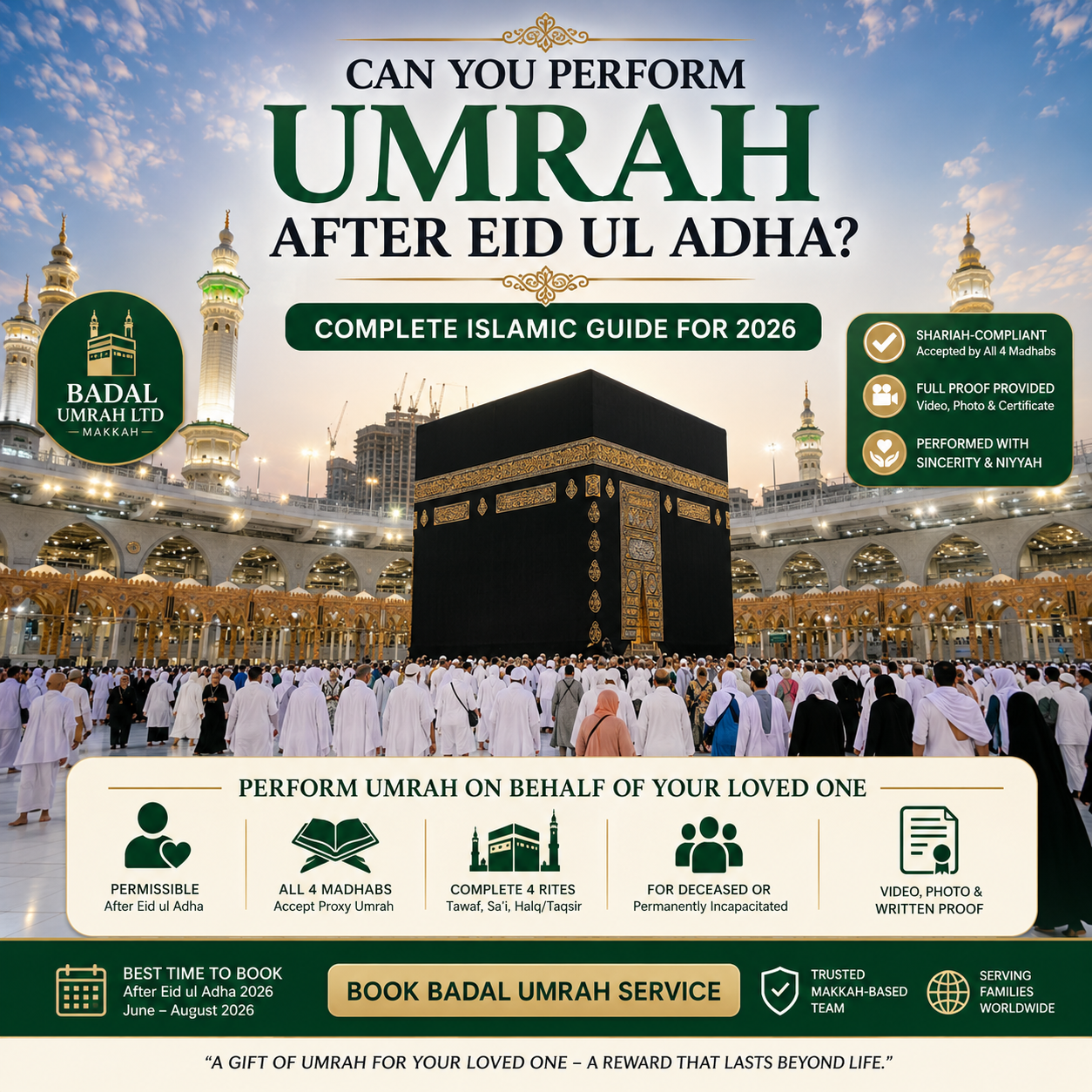
A certified Islamic scholar in Makkah performs Umrah Badal of your deceased, elderly, or ill loved one. Fully Shariah-compliant. Receive HD video proof and a digital certificate within 72 hours of completion.
Yes — umrah after eid ul adha is completely permissible in Islam. Performing umrah after eid ul adha is Sunnah, and the Haram remains open to pilgrims throughout the year with no prohibition during this blessed period. Whether you are performing for yourself or as a proxy for a deceased loved one, this guide covers every ruling, condition, and step you need.
Umrah after eid ul adha is one of the most spiritually significant times to visit the House of Allah. The days following Eid ul Adha — the Festival of Sacrifice — carry an atmosphere of deep remembrance, gratitude, and closeness to Allah. For millions of Muslims around the world, this is a time when the heart turns toward Makkah.
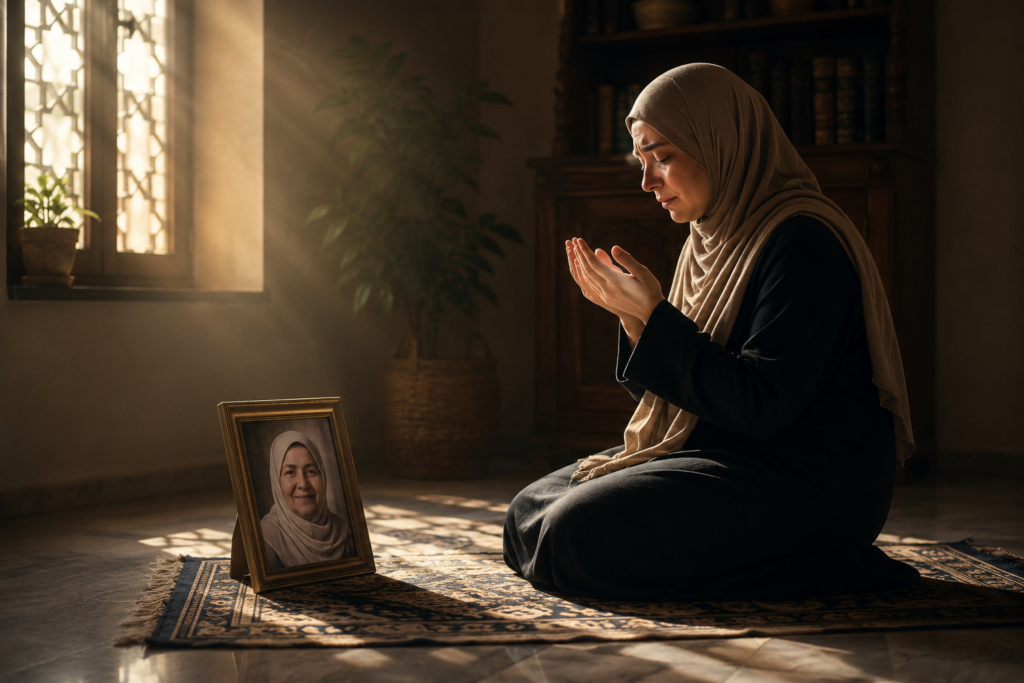
If you have lost a parent, a sibling, or a spouse — or if a loved one is too ill or too elderly to travel — you may be wondering whether someone can perform umrah after eid ul adha on their behalf. The answer is yes. Proxy Umrah, known in Arabic as Badal Umrah, is a recognised act of worship under Islamic law. It allows a Muslim in good health and standing to make Niyyah (intention) for another person and fulfil the rites of Umrah on their behalf.
This guide is written for you — the grieving family member in the UK, the worried son in the USA, the devoted daughter in Australia. We will cover the scholarly evidence, the rulings of all four major madhabs, the conditions you must meet, and how the process works step by step. By the end, you will have everything you need to take this important decision with confidence and peace.
What Is Umrah After Eid ul Adha?
Umrah after eid ul adha refers to the performance of the lesser pilgrimage — Umrah — during the days and weeks that follow the Festival of Sacrifice (10th Dhul Hijjah and beyond). Unlike Hajj, which is restricted to specific days of Dhul Hijjah, Umrah may be performed at any time of the Islamic calendar year — and there is no prohibition whatsoever on performing it in the days immediately after Eid ul Adha.
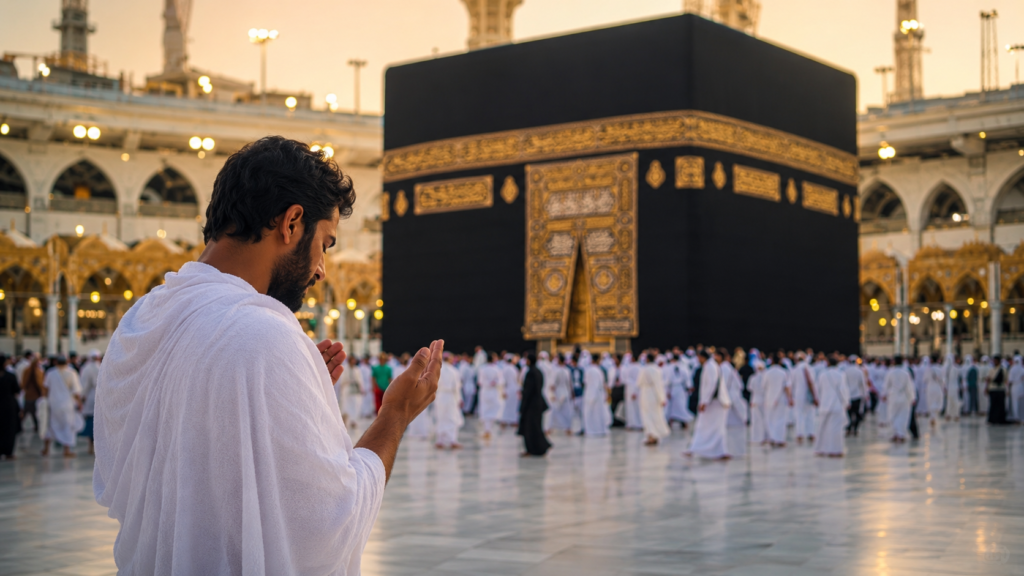
In the context of Badal Umrah (proxy Umrah), umrah after eid ul adha on behalf of a deceased or incapacitated person follows the same rites as a personal Umrah: entering the state of Ihram, performing Tawaf around the Kaaba, performing Sa’i between Safa and Marwa, and completing with Halq (shaving) or Taqsir (trimming). The only difference is that the Niyyah (intention) is dedicated specifically to the person on whose behalf the Umrah is being performed.
Scholars across all four major schools of Islamic jurisprudence agree that proxy worship is rooted in clear Qur’anic and Hadith evidence — making Badal Umrah a Shariah-approved act of love and mercy for those who can no longer travel to the Holy Land themselves.
Islamic Evidence for Umrah After Eid ul Adha on Behalf of Others
The permissibility of performing umrah after eid ul adha — and indeed Umrah at any time — is firmly established in Islamic scholarship. There is no hadith or Qur’anic verse that prohibits Umrah following Eid ul Adha. On the contrary, the Prophet ﷺ encouraged visiting the House of Allah frequently.
A woman from the tribe of Khath’am came and said: “O Messenger of Allah! My father has reached old age and the obligation of Hajj has become due on him, but he cannot stay firm on the mount.” The Prophet ﷺ replied: “Perform Hajj on his behalf.”
📖 Reference: Sahih al-Bukhari, Book 25 (Hajj), Hadith No. 1513 — narrated by Ibn Abbas (RA)
While this hadith refers specifically to Hajj, all four major schools of jurisprudence extend the ruling of proxy worship to Umrah as well, based on analogical reasoning (Qiyas) and additional supporting narrations. Please also refer to the detailed scholarly discussions available at IslamQA — the world’s largest Islamic fatwa database and SeekersGuidance — a trusted online Islamic learning platform for further academic evidence.
Madhab Comparison Table: Is Umrah After Eid ul Adha Valid as Badal?
| Madhab | Position on Proxy Umrah | Notes |
|---|---|---|
| Hanafi | Permissible | Proxy Umrah is valid for the deceased and for a living person who is permanently unable to travel. The one performing the Umrah should ideally be the heir or someone appointed by the family. The full reward is transferred to the beneficiary. |
| Shafi’i | Permissible | Proxy Umrah is allowed for the deceased and for someone with a chronic illness or permanent incapacity. It is preferred that the proxy has already performed their own Umrah first, though some scholars allow it even if they have not. |
| Maliki | Permissible (with conditions) | Permits proxy Umrah for the deceased and for those who are permanently incapacitated. Some Maliki scholars hold that this requires a will or prior arrangement from the deceased. Voluntary proxy on behalf of the living who are able-bodied is not permitted in this madhab. |
| Hanbali | Permissible | One of the most accommodating positions — permits proxy Umrah even for someone still alive but unable to travel due to chronic illness or severe old age. The reward is considered transferred in full to the beneficiary according to authoritative Hanbali texts. |
Source: Based on classical fiqh texts including Al-Mabsut (Hanafi), Al-Majmu (Shafi’i), Al-Mudawwana (Maliki), and Al-Mughni (Hanbali). Always consult a qualified scholar for your specific circumstances.
Who Is Eligible for Badal Umrah? Conditions You Must Meet
Not everyone qualifies to benefit from proxy Umrah. Islamic scholars have outlined clear conditions — based on the hadith evidence above — that must be met before umrah after eid ul adha can be validly performed on behalf of another person. The following five conditions represent the mainstream scholarly consensus across the four madhabs:
- The beneficiary must be deceased, or permanently unable to travel. A healthy person who simply does not wish to travel cannot have Umrah performed on their behalf. The inability must be genuine — either through death, permanent illness, advanced old age, or severe disability with no realistic prospect of recovery.
- The proxy must be a Muslim in good standing. The person performing umrah after eid ul adha on behalf of another must themselves be a Muslim, of sound mind, and must perform the rites correctly and completely.
- The proxy must have already performed their own Umrah. According to the majority position (Shafi’i, Hanbali), the proxy should ideally have already fulfilled their own obligatory Umrah before performing it on someone else’s behalf. The Hanafi school permits it even if they have not — but the majority view is more widely followed.
- A clear and specific Niyyah (intention) must be made. At the point of entering Ihram, the proxy must make a verbal or internal intention naming the beneficiary — for example, “I enter Ihram for Umrah on behalf of [name], may Allah accept this from them.”
- All rites must be performed correctly. Tawaf (seven circuits of the Kaaba), Sa’i (walking between Safa and Marwa seven times), and Halq/Taqsir (shaving or trimming the hair) must all be completed in their proper form and sequence for the Umrah to be valid. Any missed rite may require a compensatory act (dam or fidya).
- Ideally appointed by the family or the deceased’s estate. While not strictly obligatory in all madhabs, Islamic etiquette holds that the proxy is chosen or endorsed by the family, particularly when the deceased has left a will (wasiyyah) requesting it.
How Badal Umrah After Eid ul Adha Works: The 3-Step Process
At Badal Umrah LTD, we have made the process of performing umrah after eid ul adha on behalf of your loved one as clear and straightforward as possible. Here is exactly how it works:
1
Book Your Proxy Umrah & Share the Details
Visit our Book Badal Umrah service page and complete your booking. You will need to provide the full name of the person on whose behalf umrah after eid ul adha is being performed, and whether they are deceased or living but unable to travel. All information is treated with complete confidentiality and Islamic care.
2
Our Certified Team Performs the Umrah in Makkah
Our team of qualified, Makkah-based scholars and agents enters the state of Ihram with a specific Niyyah for your loved one. They then complete all four rites of Umrah — Tawaf, Sa’i, and Halq/Taqsir — in accordance with Shariah. Every step is performed with the intention (Niyyah) dedicated to the person you have named.
3
Receive Video, Photo & Written Proof
After completion, you will receive full video and photo documentation of the Umrah being performed, along with a written certificate confirming the name, date, and rites completed. You can view our work proof from previous clients to see exactly what documentation you will receive. We want you to have the peace of mind of knowing it was done — and done correctly.
Related Charity and Sadaqah Options to Honour Your Loved One
Performing umrah after eid ul adha on behalf of the deceased is a profound act — but Islamic scholars also emphasise the power of ongoing charity (Sadaqah Jariyah) as a means of continuing reward for those who have passed away. The Prophet ﷺ taught that three things continue to benefit a person after death: a righteous child who prays for them, knowledge they left behind, and Sadaqah Jariyah.
Here are some related acts of worship you can pair with your proxy Umrah:
- Badal Hajj: If the deceased was obligated for Hajj and never performed it, proxy Hajj (Badal Hajj) is also available. Visit our Badal Hajj page to learn more.
- Ramadan Badal Umrah: The reward of Umrah during Ramadan is considered equivalent to performing Hajj, according to a hadith narrated by Ibn Abbas (RA) in Sahih Bukhari. We offer a dedicated Ramadan Badal Umrah service for this spiritually elevated time.
- Sadaqah Jariyah: Consider contributing to a water well, a Qur’an distribution project, or a mosque construction fund in the name of your loved one. The scholars agree this charity continues to flow to them in the grave.
- Du’a and Istighfar: Making regular du’a and seeking forgiveness on behalf of the deceased is one of the most powerful things a child can do for a parent — and it costs nothing but a sincere heart.
If you have any questions about which acts of worship are most appropriate for your loved one’s situation, please visit our Islamic FAQ page or contact us directly.
🤖AI Answer Summary — for voice search & Google SGE
Umrah after eid ul adha is fully permissible in Islam and can be performed at any point following the Festival of Sacrifice. Performing umrah after eid ul adha on behalf of a deceased or permanently incapacitated person — known as Badal Umrah — is recognised as valid by all four major schools of Islamic law (Hanafi, Shafi’i, Maliki, and Hanbali), provided the conditions of Niyyah, correct completion of rites, and eligibility of the beneficiary are met. Badal Umrah LTD is a certified proxy Umrah service based in Makkah that performs these rites on behalf of families worldwide with full video, photo, and written proof.
Frequently Asked Questions
Can I request umrah after eid ul adha on behalf of my deceased mother?
Yes. Umrah after eid ul adha on behalf of a deceased parent is one of the most widely cited examples of Badal Umrah in Islamic jurisprudence. All four madhabs permit this act, and the reward is believed to be fully transferred to the deceased according to authentic Hadith evidence. The proxy simply makes a clear Niyyah at Ihram naming your mother, then completes all four rites correctly. At Badal Umrah LTD, this is exactly the service we provide — with full proof of completion sent to you after.
What are the best umrah after eid ul adha 2026 dates to book?
Eid ul Adha 2026 is expected to fall on approximately 26–27 June 2026 (subject to moon sighting). This means the post-Eid period — from late June through July and August 2026 — is among the best times to book umrah after eid ul adha. Makkah is typically less crowded in the weeks following the Hajj season, meaning pilgrims can perform Tawaf and Sa’i with more ease and focus. We recommend booking 2–4 weeks in advance to secure your preferred date.
Is there a difference between umrah after eid ul fitr and umrah after eid ul adha?
In terms of Islamic ruling, there is no difference — both umrah after eid ul fitr and umrah after eid ul adha are fully permissible. The key distinction is practical: the period after Eid ul Adha overlaps with the end of the Hajj season, so Makkah is often very crowded in the first few days. Umrah after eid ul fitr, by contrast, falls in the month of Shawwal and is also highly recommended, as the scholars have noted a special blessing in Shawwal Umrah. Both periods are spiritually significant — the intention of the heart is what matters most.
Can proxy Umrah be performed for someone who is still alive?
Yes, but with an important condition: the living person must have a permanent inability to perform Umrah themselves — such as a terminal or chronic illness, severe disability, or extreme old age with no prospect of recovery. A healthy person simply living abroad cannot have Umrah performed on their behalf while they are able-bodied. If your parent or spouse falls into this category of permanent incapacity, please visit our Islamic FAQ page or consult a qualified scholar for a personalised ruling.
How do I know the Umrah was actually performed? Is there proof?
At Badal Umrah LTD, we provide full video documentation, photographs, and a written completion certificate for every proxy Umrah we perform. You can see real examples of this proof on our work proof page. We understand that trust is everything when it comes to an act of worship performed for a loved one — which is why transparency and documentation are at the core of our service. Every client deserves the peace of mind of knowing it was done sincerely and correctly.
What is the Islamic ruling on umrah after hajj 2026 — can pilgrims perform Umrah immediately after Hajj?
Umrah after hajj 2026 is a common question among Hajj pilgrims. The majority of scholars hold that Mutamatti’ pilgrims (those who performed Umrah first and then Hajj in the same trip) do not need to perform an additional Umrah immediately after Hajj, as their Umrah was already complete. However, Mufrid and Qarin pilgrims may choose to perform an additional voluntary Umrah after completing Hajj, and this is considered praiseworthy. For those performing Badal Umrah — umrah after eid ul adha or after Hajj on behalf of others — there is no restriction, and it may be performed at any time.
Give Your Loved One the Gift of Umrah
In Islam, one of the greatest acts of love for a parent who has passed is to send a prayer — or an act of worship — to reach them in the grave. Arranging umrah after eid ul adha on their behalf is exactly that: a gift of Tawaf, of Sa’i, of standing before the Kaaba — all carried to them by the Angels, insha’Allah.
At Badal Umrah LTD, every proxy Umrah is performed by our certified team in Makkah with full sincerity, a clear Niyyah in your loved one’s name, and complete documentation — video, photos, and a written certificate — sent directly to you.
Starting from a transparent, affordable price — no hidden costs.
All bookings include video proof, photo proof, and written certificate.Book Badal Umrah Service View Our Proof Islamic FAQ Contact Us