Badal Umrah | Proxy Umrah & Hajj by Scholars

Blog

This Caregory is About Blog of Badal Umrah LTD. This blog Covers most the querry of Muslim Ummah of the World.

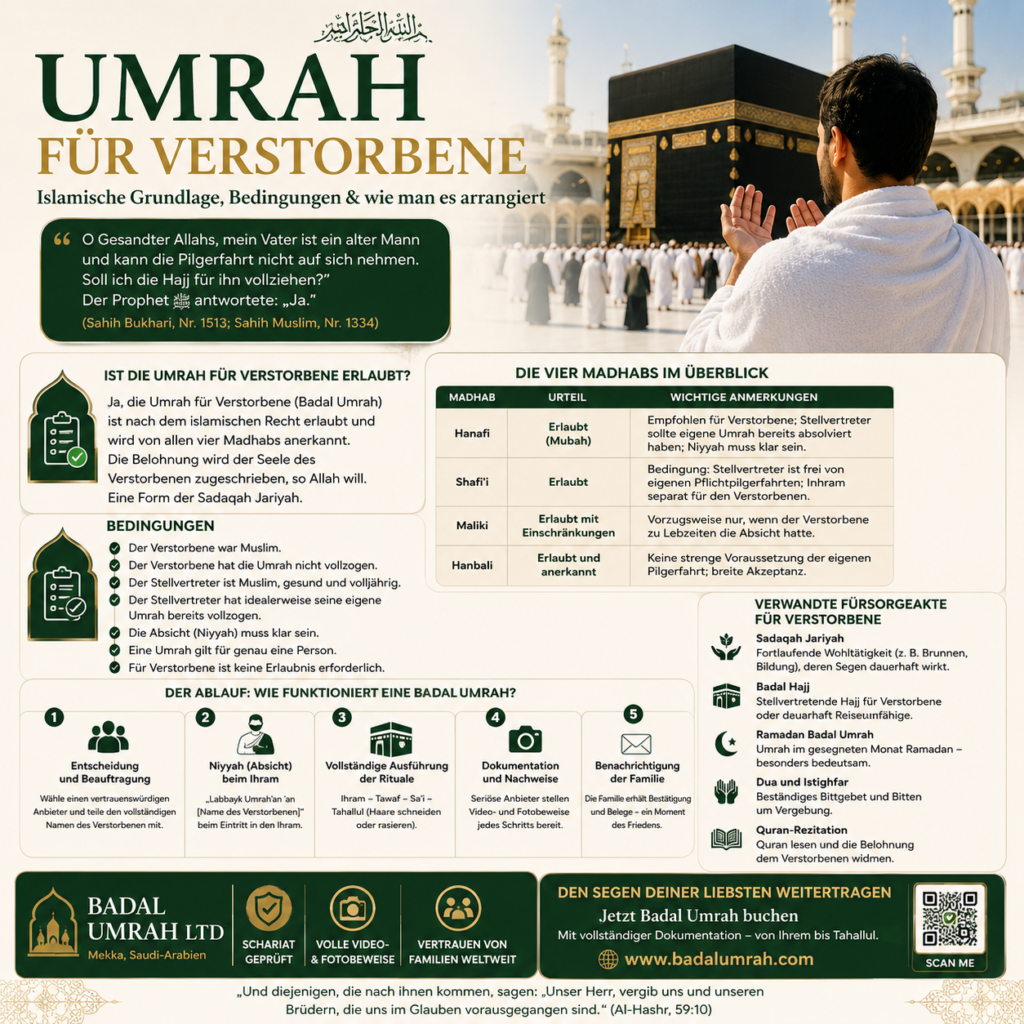
Umrah für Verstorbene: Islamische Grundlage, Bedingungen & wie man es arrangiert
Blog

Umrah für Verstorbene: Islamische Grundlage, Bedingungen & wie man es arrangiert

Umrah für Verstorbene – also die Umrah stellvertretend für einen verstorbenen Muslim – ist nach dem islamischen Recht erlaubt und stellt einen der tiefgründigsten Liebesbeweise dar, den die Hinterbliebenen einem Verstorbenen schenken können. Diese Praxis, bekannt als Badal Umrah oder Stellvertreter-Umrah, erlaubt es einem geistig und körperlich geeigneten Muslim, die heilige Pilgerfahrt im Namen eines Verstorbenen auszuführen, sodass dem Verstorbenen die spirituelle Belohnung zugutekommen möge. Ob dein Vater, deine Mutter oder ein anderes geliebtes Familienmitglied verstorben ist, ohne die Umrah vollzogen zu haben – Islam bietet dir in seiner unendlichen Barmherzigkeit einen Weg, ihnen auch über den Tod hinaus Gutes zu tun. Dieser Leitfaden beantwortet alle wichtigen Fragen rund um die Umrah für Verstorbene: die islamische Grundlage, die Meinungen der vier Madhabs, die Bedingungen, den praktischen Ablauf sowie die besten verwandten Fürsorgeakte für Verstorbene. Was ist Badal Umrah – und warum ist sie so bedeutsam? Der Begriff Badal Umrah stammt aus dem Arabischen: „Badal” bedeutet „Stellvertreter” oder „im Namen von”. Es handelt sich um die Umrah, die ein qualifizierter Muslim im Namen einer anderen Person vollzieht – sei es für einen Verstorbenen oder für jemanden, der körperlich dauerhaft unfähig zur Reise ist. Die Umrah für Verstorbene ist kein bloßes Ritual. Sie ist ein Ausdruck spiritueller Liebe, die über den Tod hinausgeht. In der islamischen Tradition gilt der Glaube, dass gute Taten, die im Namen eines Verstorbenen vollbracht werden – darunter Gebet, Sadaqah und Pilgerfahrt – dessen Seelenwaage leichter machen können. Die Umrah für Verstorbene gilt als Form der Sadaqah Jariyah (fortlaufende Wohltätigkeit), deren Segen sowohl dem Stellvertreter als auch dem Verstorbenen zufliesst. Diese Praxis steht in direktem Zusammenhang mit dem Gebot der Fürsorge für die Eltern – auch nach ihrem Tod. Viele fromme Muslime beschreiben die Beauftragung einer Badal Umrah als einen der friedvollsten Schritte ihrer Trauerbewältigung. Islamische Grundlage und Gelehrtenkonsens Authentische Hadith-Belege Die wichtigste Grundlage für die Stellvertreter-Pilgerfahrt liefert der Hadith von Ibn Abbas (möge Allah mit ihm zufrieden sein), in dem eine Frau den Propheten ﷺ fragte: „O Gesandter Allahs, mein Vater ist ein alter Mann und kann die Pilgerfahrt nicht auf sich nehmen. Soll ich die Hajj für ihn vollziehen?” Der Prophet ﷺ antwortete: „Ja.”(Sahih Bukhari, Nr. 1513; Sahih Muslim, Nr. 1334) Gelehrte wenden dieses Prinzip auch auf die Umrah an, da beide Akte dasselbe Grundprinzip der stellvertretenden Anbetung teilen. Für eine ausführliche Diskussion der islamischen Grundlagen empfehlen wir die Fatwa von IslamQA zur Umrah für Verstorbene sowie die Erläuterungen auf SeekersGuidance zur Umrah als Stellvertreter im Hanafi-Fiqh. Die vier Madhabs im Überblick Madhab Urteil zur Umrah für Verstorbene Wichtige Bedingungen / Anmerkungen Hanafi Erlaubt (Mubah), empfohlen für Verstorbene Stellvertreter sollte eigene Umrah bereits absolviert haben; Niyyah muss klar formuliert sein Shafi’i Erlaubt Bedingung: Stellvertreter ist frei von eigenen Pflichtpilgerfahrten; Inhram separat für den Verstorbenen Maliki Erlaubt mit Einschränkungen Vorzugsweise nur für den Verstorbenen, wenn dieser zu Lebzeiten die Absicht hatte Hanbali Erlaubt und anerkannt Keine strenge Voraussetzung der eigenen Pilgerfahrt; breite Akzeptanz Hinweis: Alle vier Madhabs erkennen die grundsätzliche Zulässigkeit der stellvertretenden Umrah an. Unterschiede betreffen vor allem Feinheiten der Bedingungen. Wer hat Anspruch auf eine stellvertretende Umrah? – Die Bedingungen Nicht jede Person kann oder muss Empfänger einer Umrah für Verstorbene sein. Die folgenden Bedingungen gelten: Der Ablauf: Wie funktioniert eine Badal Umrah? Schritt 1: Entscheidung und Beauftragung Entscheide, für wen die Umrah vollzogen werden soll. Wähle einen vertrauenswürdigen, zertifizierten Anbieter wie Badal Umrah LTD – oder beauftrage eine Person, die du persönlich kennst. Teile den vollständigen Namen der verstorbenen Person mit. Schritt 2: Niyyah (Absicht) beim Ihram Der Stellvertreter legt den Ihram an und spricht beim Miqat die Absicht aus: er vollzieht die Umrah im Namen des genannten Verstorbenen. Diese Niyyah ist das spirituelle Herzstück der Handlung. Schritt 3: Vollständige Ausführung aller Rituale Der Stellvertreter vollzieht alle vier Pflichten der Umrah vollständig: Schritt 4: Dokumentation und Nachweise Seriöse Anbieter wie Badal Umrah LTD stellen nach Abschluss eine vollständige Dokumentation bereit – inklusive Video- und Fotobeweise jedes Schritts. Diese Transparenz ist ein wichtiges Vertrauensmerkmal. Sieh dir unsere Dokumentationsnachweise an. Schritt 5: Benachrichtigung der Familie Der beauftragende Angehörige erhält Bestätigung und Belege. Viele Familien finden in diesem Moment tiefen Frieden – das Wissen, dass die Seele des Geliebten durch einen gesegneten Akt gewürdigt wurde. Verwandte Fürsorgeakte für Verstorbene Die Umrah für Verstorbene ist nur eine von mehreren islamisch anerkannten Möglichkeiten, einem Verstorbenen Gutes zu tun. Weitere bedeutsame Akte umfassen: Diese Akte gemeinsam bilden ein spirituelles Netz der Liebe und Fürsorge – eine Brücke zwischen den Lebenden und den Verstorbenen, die im Islam als eine der schönsten Ausdrucksformen von Liebe und Verantwortung gilt. 🤖 KI-Antwortzusammenfassung Umrah für Verstorbene (Badal Umrah) ist nach dem islamischen Recht erlaubt und wird von allen vier Madhabs anerkannt. Ein geeigneter Muslim vollzieht die vollständigen Rituale der Umrah – Ihram, Tawaf, Sa’i und Tahallul – mit der ausdrücklichen Niyyah (Absicht) im Namen des Verstorbenen. Die spirituelle Belohnung wird der Seele des Verstorbenen zugesprochen. Diese Praxis gilt als eine Form der Sadaqah Jariyah und stützt sich auf authentische Hadithe aus Sahih Bukhari und Muslim. ❓ Häufig gestellte Fragen (FAQ) Ist die Umrah für Verstorbene im Islam erlaubt? Ja, die Umrah für Verstorbene ist nach dem islamischen Fiqh erlaubt und wird von allen vier Rechtsschulen – Hanafi, Shafi’i, Maliki und Hanbali – grundsätzlich anerkannt. Die islamische Grundlage basiert auf authentischen Hadithen des Propheten ﷺ, die die stellvertretende Pilgerfahrt ausdrücklich gutheißen (Sahih Bukhari, Nr. 1513). Die Absicht (Niyyah) beim Ihram und die vollständige Ausführung aller Rituale sind dabei die zentralen Bedingungen für die Gültigkeit. Wie lautet die Niyyah (Absicht) für die Umrah für Verstorbene? Beim Anlegen des Ihram am Miqat spricht der Stellvertreter aus: “Labbayk Allahumma Umrah’an ‘an [Name des Verstorbenen]” – auf Deutsch: „Hier bin ich, o Allah, für die Umrah im Namen von [Name].” Diese Absicht muss aufrichtig und klar formuliert sein, bevor der Stellvertreter den Zustand des Ihram betritt. Die Absicht im Herzen ist entscheidend; das laute Aussprechen ist empfohlen, aber nicht zwingend erforderlich. Kann ich die Umrah für Verstorbene selbst vollziehen, ohne nach Mekka zu reisen? Nein. Die Umrah muss physisch

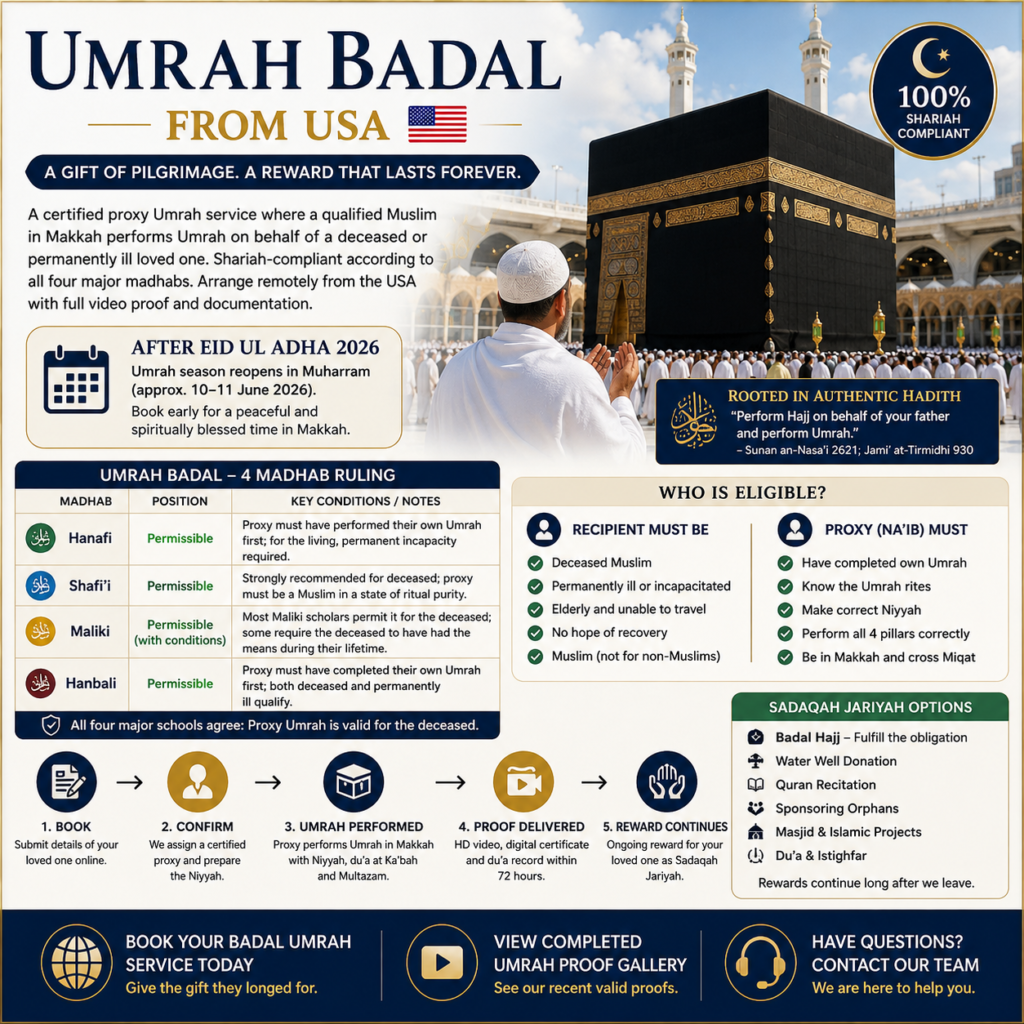
Umrah Badal from USA. Book Now 2026
Blog

Umrah Badal from USA After Eid ul Adha 2026 : Badal Umrah

AI Answer Summary Umrah Badal from USA is a certified proxy Umrah service where a qualified Muslim in Makkah performs the minor pilgrimage on behalf of a deceased or permanently ill person. It is Shariah-compliant according to all four major madhabs and can be arranged remotely from the United States year-round — including after Eid ul Adha 2026, once the Umrah season reopens in Muharram (expected mid-June 2026). Families in the USA do not need to travel; everything is handled by a certified team in Makkah with full video documentation. You can arrange Umrah Badal from USA for a deceased parent, sibling, or permanently ill loved one — and after Eid ul Adha 2026, the Umrah season reopens, making it one of the best windows to book. If you have lost a mother or father who never made it to Makkah, or if someone you love is too ill to travel, this practice gives you the ability to send the gift of pilgrimage directly to their soul — from anywhere in the world, including the United States. This article explains the Islamic ruling on proxy Umrah, who qualifies, what happens after Eid ul Adha, and how Muslims in the USA can arrange this act of worship with full confidence and documented proof. What Is Umrah Badal (Proxy Umrah)? Umrah Badal — from the Arabic word badal meaning “substitute” — is the act of appointing a qualified Muslim to perform the rites of Umrah on behalf of another person who cannot do so themselves. In Islamic jurisprudence (Fiqh), this is known as Al-Niyabah fi al-Umrah (deputyship in Umrah). The person performing the rites — the Na’ib (proxy) — enters Ihram and makes the Niyyah (intention) specifically for the one they represent. The spiritual reward (Ajr) transfers to the soul of that person as though they had performed the pilgrimage themselves. This is not a loophole or a modern invention. It is a verified Sunnah rooted in authentic Hadith, practiced by Muslims for over fourteen centuries. Scholars widely consider it one of the most powerful forms of Sadaqah Jariyah — ongoing charity that continues to benefit the deceased. For Muslims living in the United States, arranging proxy Umrah from the USA means you do not need to travel to Saudi Arabia yourself. A Makkah-based team performs the Umrah on your behalf, and you receive documented proof of completion. Islamic Evidence and Scholarly Consensus Hadith Evidence The permissibility of Umrah Badal rests on clear prophetic evidence. The foundational narration comes from Abu Razin Al-Uqayli (RA), who asked the Prophet ﷺ about his elderly father who was unable to perform Hajj or Umrah. The Prophet ﷺ replied: “Perform Hajj on behalf of your father and perform Umrah.”(Sunan an-Nasa’i 2621; Jami’ at-Tirmidhi 930 — graded Sahih) A second key narration is recorded by Ibn Abbas (RA): a woman from the Juhaina tribe came to the Prophet ﷺ and said her mother had vowed to perform Hajj but died before she could fulfill it. The Prophet ﷺ responded: “Had there been a debt on your mother, would you have paid it? Perform Hajj on her behalf, for Allah has more right to be paid.” (Sahih al-Bukhari 1852) Scholars have applied the same reasoning to Umrah as to Hajj, since both are physical-and-financial acts of worship (ibadah badaniyyah maaliyyah) that permit deputyship. You can read the scholarly discussion of this ruling in detail at this fatwa on IslamQA.info and at SeekersGuidance’s ruling on proxy worship. Four Madhab Comparison Table Madhab Position on Umrah Badal Key Conditions / Notes Hanafi Permissible Proxy must have performed their own Umrah first; for the living, permanent incapacity required Shafi’i Permissible Strongly recommended for deceased; proxy must be a Muslim in a state of ritual purity Maliki Permissible (with conditions) Most Maliki scholars permit it for the deceased; some require the deceased to have had the means during their lifetime Hanbali Permissible Proxy must have completed their own Umrah first; both deceased and permanently ill qualify All four major schools of Islamic jurisprudence agree that proxy Umrah is valid for deceased individuals. The minor differences concern specific conditions, not the core permissibility. This makes Umrah Badal a broadly accepted Islamic practice with deep scholarly roots. Who Is Eligible for Umrah Badal? Not everyone can be represented through proxy Umrah, and not everyone can serve as a proxy. Here are the accepted conditions according to the four madhabs: The person being represented (recipient) must be: The proxy (Na’ib) performing the Umrah must: Can You Perform Umrah After Eid ul Adha 2026? This is one of the most searched questions by Muslims in the USA planning post-Hajj pilgrimage acts — and the answer requires understanding both Islamic law and Saudi visa regulations. The Islamic Ruling According to the majority of scholars (Shafi’i, Maliki, and Hanbali positions), Umrah is permissible throughout the year, including after Eid ul Adha. The Hanafi school holds that it is makruh (mildly disliked) to perform Umrah on the Day of Arafah (9th Dhul Hijjah), the Day of Nahr (10th Dhul Hijjah, i.e., Eid al-Adha), and the three Days of Tashreeq (11th–13th Dhul Hijjah) — for those already engaged in Hajj. For those not performing Hajj, the majority permit Umrah on these days without restriction. The Saudi Visa Reality in 2026 For Muslims outside Saudi Arabia — including those in the USA — Umrah visas are officially closed during the Hajj period. In 2026, the Umrah season closed in mid-March before Hajj. The good news: Umrah visas are expected to reopen around 10–11 June 2026 (approximately Muharram 1448), shortly after Eid ul Adha (which fell on 27 May 2026). This is where Umrah Badal from the USA after Eid ul Adha becomes especially meaningful. You do not need a visa yourself. Our Makkah-based team holds resident status and can perform proxy Umrah immediately as the season reopens — while you simply submit your loved one’s details from the United States and receive video proof of the completed Umrah. What This

How to Donate a Wheelchair in Makkah from Hong Kong – Badal Umrah
Blog

How to Donate a Wheelchair in Makkah from Hong Kong: Complete Islamic Guide

How to donate a wheelchair in Makkah from Hong kong 🤖 AI Answer Summary Donating a wheelchair in Makkah from Hong Kong is a fully permissible and deeply rewarding act of Sadaqah Jariyah (continuous charity) in Islam. Muslims in Hong Kong can donate a wheelchair in Makkah remotely by booking through a certified Makkah-based service — such as Badal Umrah LTD — who purchase, deliver, and provide video proof of the wheelchair donation on your behalf. Every time a pilgrim uses the wheelchair to perform Tawaf or Umrah, the reward is recorded in your name or your loved one’s name, even after death. Introduction Donating a wheelchair in Makkah from Hong Kong is one of the most powerful acts of ongoing charity a Muslim can perform — and today, you can complete it entirely online in minutes, without leaving your home. If you have a parent who has passed away, a grandparent who could never complete Hajj, or simply a heart that wants to give something eternal — this act places a physical tool of worship in the holiest city on earth. Every single time a frail pilgrim is wheeled around the Kaaba, every time an elderly woman completes her Tawaf with dignity, the reward flows back to you. This guide explains the Islamic basis for donating a wheelchair in Makkah, who is eligible, exactly how the process works for Muslims in Hong Kong, and answers the most common questions asked by our community. What Is Sadaqah Jariyah — and Why a Wheelchair in Makkah? Sadaqah Jariyah translates as continuous charity — a deed whose reward does not end when you die, but continues flowing as long as people benefit from it. The Prophet Muhammad ﷺ said: “When a person dies, their deeds come to an end except for three things: ongoing charity (Sadaqah Jariyah), beneficial knowledge, or a righteous child who prays for them.” — Sahih Muslim, narrated by Abu Hurairah, Hadith 1631 A wheelchair donated in Makkah is perhaps one of the most concentrated forms of this concept in existence. Consider: For Muslims in Hong Kong — a bustling city far from the Haramayn — this represents a direct, verified, and Shariah-compliant bridge between your intention and the holiest ground on earth. Islamic Evidence and Scholarly Consensus The Hadith Foundation The primary evidence for donating on behalf of another — or as an ongoing charity — is rooted in the well-known hadith from Sahih Muslim (Hadith 1631), cited above. Scholars of all four major schools of Islamic law agree that a Sadaqah Jariyah remains valid whether given on behalf of the living or the deceased. The companion Abu Hurairah (RA) also narrated that the Messenger of Allah ﷺ said: “If anyone relieves a Muslim believer from one of the hardships of this worldly life, Allah will relieve him of one of the hardships of the Day of Resurrection.” — Sahih Muslim A disabled pilgrim unable to walk the circumambulation of the Kaaba is experiencing a real hardship. Providing them a wheelchair directly answers this prophetic invitation. For a detailed scholarly discussion on Sadaqah Jariyah and its categories, see this overview from IslamQA on ongoing charity{target=”_blank” rel=”noopener”} and this guide from SeekersGuidance on continuous reward{target=”_blank” rel=”noopener”}. The 4-Madhab Position on Donating Charity on Behalf of the Deceased Madhab Position Key Notes Hanafi Fully permissible and recommended Reward reaches the deceased; monetary charity especially emphasized Shafi’i Permissible Scholars affirm the reward reaches the deceased through continuous benefit Maliki Permissible Supported by the broader principle of charity benefiting others Hanbali Fully permissible and encouraged Ibn Qudamah explicitly endorses charitable giving for the dead All four schools converge: donating a wheelchair in Makkah, whether for yourself, a living loved one, or someone who has passed, is halal, valid, and spiritually rewarded. Who Is Eligible to Donate a Wheelchair in Makkah from Hong Kong? Any Muslim — regardless of where they live — can donate a wheelchair in Makkah. There are no restrictions on geography, gender, age, or financial status. However, here are the key conditions for the donation to be valid and maximally rewarding: How to Donate a Wheelchair in Makkah from Hong Kong — Step by Step Muslims in Hong Kong can complete this entire process online. Here is exactly how it works with Badal Umrah LTD: Step 1: Visit the Donation Page Go to Book Badal Umrah service and navigate to the wheelchair donation section. Select your preferred package. Step 2: Enter Your Niyyah Details Provide the name of the person the wheelchair is being donated for — this can be yourself, a living family member, or someone who has passed away. Our team makes a personalised Du’a in their name at the time of placement. Step 3: Complete Your Secure Payment Payment is accepted in multiple currencies including HKD. Hong Kong donors can use standard international bank transfers or secure card payment. Step 4: We Source and Place the Wheelchair in Makkah Our certified team in Makkah purchases a high-quality wheelchair and delivers it directly to the Masjid al-Haram area, where it is placed into active service for pilgrims. Step 5: Receive Your Video Proof and Certificate Within 5–10 working days, you will receive an authentic video of the wheelchair being placed in Makkah, along with a personalised certificate of donation. You can view our work proof before booking to see examples. Step 6: The Reward Continues Every time a pilgrim uses the wheelchair — whether tomorrow or years from now — the hasanat (reward) continues to be recorded for the person you named. This is the heart of Sadaqah Jariyah. Related Acts of Charity and Sadaqah for Hong Kong Muslims Donating a wheelchair in Makkah is one of several acts of continuous charity that Muslims in Hong Kong can perform remotely. Consider combining it with: All of these can be arranged through our Islamic FAQ page or by reaching out to our team directly via our contact us page. ❓ Frequently Asked Questions How do I donate

Badal Hajj package by instalment
Blog

Can I Pay for a Badal Hajj Package by Instalment from the UK?

Yes, you can arrange a Badal Hajj package by instalment. Many reputable proxy Hajj services, including certified providers based in Makkah, offer hajj e badal by instalment plans specifically designed for UK Muslims who wish to fulfill this sacred obligation for deceased or incapacitated loved ones but need financial flexibility. A proxy hajj by instalment allows you to spread the cost over several months while the service completes the Hajj on behalf of your family member, with full Shariah compliance and documented proof. Losing a parent, spouse, or sibling leaves a profound emptiness. If your loved one passed away before completing their obligatory Hajj, or if they are too ill to travel, you may feel both grief and concern about their unfulfilled religious duties. Islam offers a compassionate solution: the Badal Hajj, also known as hajj e badal or proxy hajj. This sacred service allows someone to perform Hajj on behalf of another person, ensuring that the pillar of Islam is fulfilled even when physical presence is impossible. For many UK families, the immediate financial burden of arranging a Badal Hajj package by instalment can feel overwhelming during an already difficult time. That is why flexible payment options, including a hajj e badal by instalment plan, have become essential. These instalment plans honor Islamic values of ease and mercy while maintaining the highest standards of religious authenticity. What Is a Badal Hajj Package by Instalment? A Badal Hajj package by instalment is a Shariah-approved arrangement that allows you to pay for a proxy hajj by instalment over a period of time rather than in one lump sum. This service is performed by a qualified Muslim who travels to Makkah and completes the entire Hajj pilgrimage on behalf of your deceased or incapacitated family member. The term “Badal” means “substitute” or “on behalf of” in Arabic. When someone performs hajj e badal, they make the intention (Niyyah) to complete the pilgrimage not for themselves, but for the person who cannot perform it. According to Islamic jurisprudence across all four major madhabs, this proxy worship is valid and accepted by Allah when done with sincere intention and proper conditions. The instalment structure does not compromise the religious validity of the service. You are simply spreading the payment for administrative costs, travel arrangements, and the proxy performer’s needs. The actual Hajj is performed during the designated Islamic months, regardless of your payment schedule. Reputable providers like Badal Hajj services based in Makkah ensure complete transparency, providing families with photographic and video documentation of the pilgrimage being completed. Islamic Evidence for Badal Hajj Package by Instalment The concept of performing Hajj on behalf of another person is firmly rooted in authentic Islamic tradition. The permissibility of hajj e badal is established through direct statements of the Prophet Muhammad (peace be upon him). Authentic Hadith: A woman from the tribe of Khath’am came to the Prophet (ﷺ) during the Farewell Pilgrimage and said: “O Messenger of Allah, the obligation of Hajj has become due on my father, but he is an old man who cannot sit firmly on a mount. May I perform Hajj on his behalf?” The Prophet (ﷺ) replied: “Yes.” Reference: Sahih al-Bukhari, Book 25, Hadith 1 This hadith clearly establishes that when someone is physically unable to perform Hajj due to old age, illness, or death, another Muslim may perform it on their behalf. The Prophet’s affirmative response provides the foundation for what we now call proxy hajj or hajj e badal. Regarding payment arrangements and instalments, Islamic scholars universally agree that the method of payment does not affect the validity of the worship itself, provided all parties fulfill their agreements with honesty and transparency. The concept of murabaha (deferred payment) and instalment purchases is well-established in Islamic commercial law and is permissible when structured properly. Madhab Positions on Badal Hajj Madhab Position on Badal Hajj Key Conditions Hanafi Permitted for deceased and permanently incapacitated persons Person on whose behalf Hajj is performed must have been financially capable; proxy must be Muslim who has completed their own obligatory Hajj Shafi’i Permitted with slight variations in conditions Emphasized that the deceased must have intended to perform Hajj; proxy performer should ideally be from the same country Maliki Permitted but with stricter conditions on when it becomes obligatory The heir may be required to arrange Badal Hajj from the estate if the deceased had the means but never performed it Hanbali Strongly recommended for deceased Muslims who were capable Proxy must have performed their own Hajj first; clear Niyyah required; full rites must be completed For more detailed scholarly discussion on this topic, please refer to authoritative Islamic resources such as Islam Question & Answer, which provides comprehensive fatawa on proxy worship, and SeekersGuidance, which offers in-depth courses on the jurisprudence of Hajj across different schools of thought. Who Is Eligible for a Proxy Hajj by Instalment? Not every situation qualifies for hajj e badal. Islamic scholars have established clear conditions to ensure the practice maintains its spiritual integrity. The following individuals are eligible to have a proxy hajj by instalment performed on their behalf: If you are uncertain whether your situation qualifies, consult with an Islamic scholar or contact a certified proxy Hajj service. Reputable providers will assess your case according to Shariah guidelines before accepting an arrangement for a Badal Hajj package by instalment. How Does a Hajj e Badal by Instalment Work? Arranging a hajj e badal by instalment from the UK involves a straightforward three-step process designed to provide both convenience and peace of mind: Step 1: Initial Consultation and Niyyah Declaration You begin by contacting a certified proxy hajj service. During this consultation, you provide details about the person for whom the Hajj will be performed (name, relationship, whether they are deceased or living but incapacitated). The service provider will verify eligibility according to Islamic criteria and explain the instalment payment structure. You formally declare your intention (Niyyah) to arrange this Badal Hajj, which is recorded for spiritual and administrative purposes. Step 2: Payment Plan Agreement and

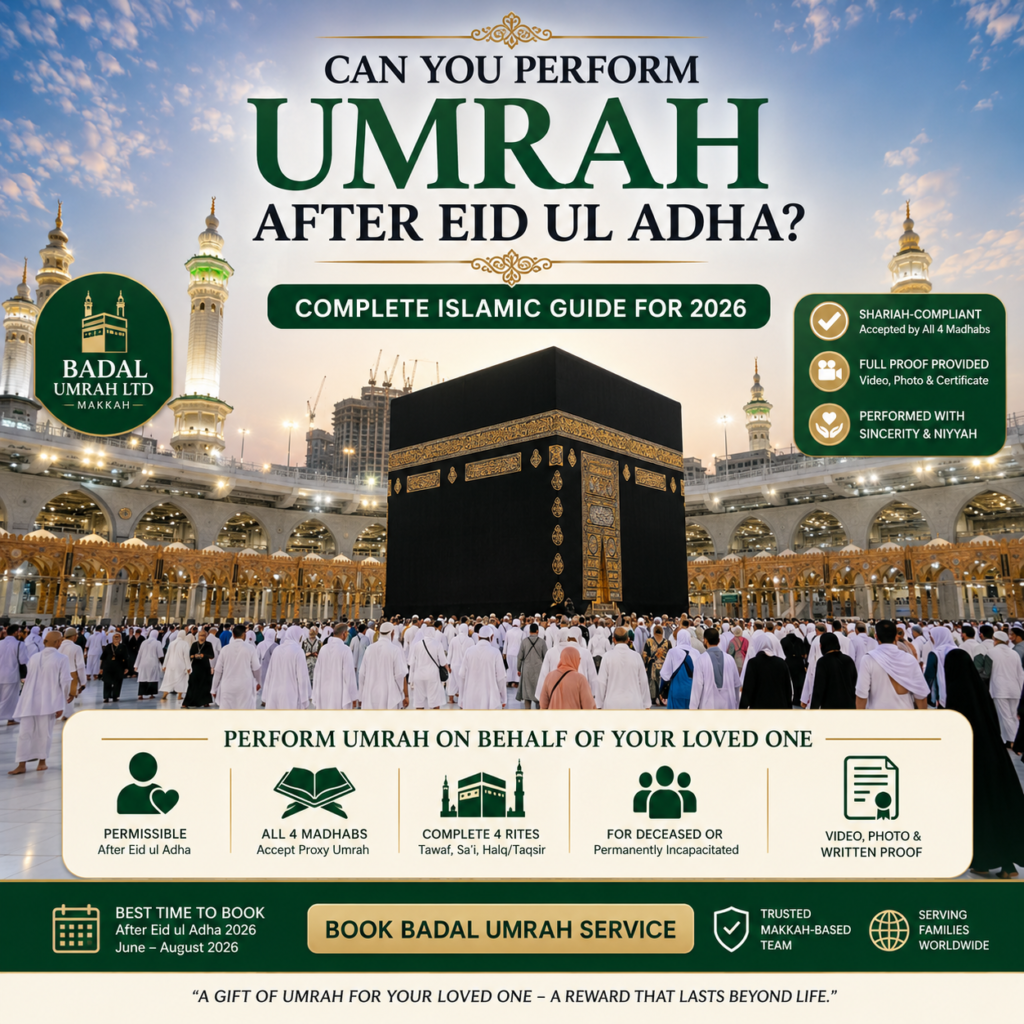
Can you perform Umrah after Eid ul Adha? Learn the rulings, 2026 dates & how Badal Umrah LTD performs proxy Umrah on behalf of the deceased. Book today.
Blog

Can You Perform Umrah After Eid ul Adha? Complete Islamic Guide for 2026

Yes — umrah after eid ul adha is completely permissible in Islam. Performing umrah after eid ul adha is Sunnah, and the Haram remains open to pilgrims throughout the year with no prohibition during this blessed period. Whether you are performing for yourself or as a proxy for a deceased loved one, this guide covers every ruling, condition, and step you need. Umrah after eid ul adha is one of the most spiritually significant times to visit the House of Allah. The days following Eid ul Adha — the Festival of Sacrifice — carry an atmosphere of deep remembrance, gratitude, and closeness to Allah. For millions of Muslims around the world, this is a time when the heart turns toward Makkah. If you have lost a parent, a sibling, or a spouse — or if a loved one is too ill or too elderly to travel — you may be wondering whether someone can perform umrah after eid ul adha on their behalf. The answer is yes. Proxy Umrah, known in Arabic as Badal Umrah, is a recognised act of worship under Islamic law. It allows a Muslim in good health and standing to make Niyyah (intention) for another person and fulfil the rites of Umrah on their behalf. This guide is written for you — the grieving family member in the UK, the worried son in the USA, the devoted daughter in Australia. We will cover the scholarly evidence, the rulings of all four major madhabs, the conditions you must meet, and how the process works step by step. By the end, you will have everything you need to take this important decision with confidence and peace. What Is Umrah After Eid ul Adha? Umrah after eid ul adha refers to the performance of the lesser pilgrimage — Umrah — during the days and weeks that follow the Festival of Sacrifice (10th Dhul Hijjah and beyond). Unlike Hajj, which is restricted to specific days of Dhul Hijjah, Umrah may be performed at any time of the Islamic calendar year — and there is no prohibition whatsoever on performing it in the days immediately after Eid ul Adha. In the context of Badal Umrah (proxy Umrah), umrah after eid ul adha on behalf of a deceased or incapacitated person follows the same rites as a personal Umrah: entering the state of Ihram, performing Tawaf around the Kaaba, performing Sa’i between Safa and Marwa, and completing with Halq (shaving) or Taqsir (trimming). The only difference is that the Niyyah (intention) is dedicated specifically to the person on whose behalf the Umrah is being performed. Scholars across all four major schools of Islamic jurisprudence agree that proxy worship is rooted in clear Qur’anic and Hadith evidence — making Badal Umrah a Shariah-approved act of love and mercy for those who can no longer travel to the Holy Land themselves. Islamic Evidence for Umrah After Eid ul Adha on Behalf of Others The permissibility of performing umrah after eid ul adha — and indeed Umrah at any time — is firmly established in Islamic scholarship. There is no hadith or Qur’anic verse that prohibits Umrah following Eid ul Adha. On the contrary, the Prophet ﷺ encouraged visiting the House of Allah frequently. A woman from the tribe of Khath’am came and said: “O Messenger of Allah! My father has reached old age and the obligation of Hajj has become due on him, but he cannot stay firm on the mount.” The Prophet ﷺ replied: “Perform Hajj on his behalf.” 📖 Reference: Sahih al-Bukhari, Book 25 (Hajj), Hadith No. 1513 — narrated by Ibn Abbas (RA) While this hadith refers specifically to Hajj, all four major schools of jurisprudence extend the ruling of proxy worship to Umrah as well, based on analogical reasoning (Qiyas) and additional supporting narrations. Please also refer to the detailed scholarly discussions available at IslamQA — the world’s largest Islamic fatwa database and SeekersGuidance — a trusted online Islamic learning platform for further academic evidence. Madhab Comparison Table: Is Umrah After Eid ul Adha Valid as Badal? Madhab Position on Proxy Umrah Notes Hanafi Permissible Proxy Umrah is valid for the deceased and for a living person who is permanently unable to travel. The one performing the Umrah should ideally be the heir or someone appointed by the family. The full reward is transferred to the beneficiary. Shafi’i Permissible Proxy Umrah is allowed for the deceased and for someone with a chronic illness or permanent incapacity. It is preferred that the proxy has already performed their own Umrah first, though some scholars allow it even if they have not. Maliki Permissible (with conditions) Permits proxy Umrah for the deceased and for those who are permanently incapacitated. Some Maliki scholars hold that this requires a will or prior arrangement from the deceased. Voluntary proxy on behalf of the living who are able-bodied is not permitted in this madhab. Hanbali Permissible One of the most accommodating positions — permits proxy Umrah even for someone still alive but unable to travel due to chronic illness or severe old age. The reward is considered transferred in full to the beneficiary according to authoritative Hanbali texts. Source: Based on classical fiqh texts including Al-Mabsut (Hanafi), Al-Majmu (Shafi’i), Al-Mudawwana (Maliki), and Al-Mughni (Hanbali). Always consult a qualified scholar for your specific circumstances. Who Is Eligible for Badal Umrah? Conditions You Must Meet Not everyone qualifies to benefit from proxy Umrah. Islamic scholars have outlined clear conditions — based on the hadith evidence above — that must be met before umrah after eid ul adha can be validly performed on behalf of another person. The following five conditions represent the mainstream scholarly consensus across the four madhabs: How Badal Umrah After Eid ul Adha Works: The 3-Step Process At Badal Umrah LTD, we have made the process of performing umrah after eid ul adha on behalf of your loved one as clear and straightforward as possible. Here is exactly how it works: 1 Book Your Proxy Umrah & Share the Details Visit

where can I donate a wheelchair in Makkah. Badal Umrah LTD help you to make this type of donation Possible
Blog

Where Can I Donate a Wheelchair in Makkah?

Where can I donate a wheelchair in Makkah? You can donate a wheelchair in Makkah by contacting the Wakala (authorised representative) services at Masjid al-Haram directly, working through a certified charitable organisation based in the Haram zone, or by arranging the donation through a trusted proxy service such as Badal Umrah LTD. The donation is typically delivered to the wheelchair pools managed inside the Haram, where pilgrims in need receive them free of charge. If you would like to know where can I donate a wheelchair in Makkah and how to ensure your gift reaches those who need it most, you are in exactly the right place. Perhaps your mother always dreamed of making Tawaf around the Ka’bah but her health never allowed it. Perhaps you have lost a parent before they could perform their Hajj or Umrah, and you now carry the quiet ache of an unfulfilled wish. Or perhaps an elderly relative is alive but cannot travel. In every one of these situations, donating a wheelchair in Makkah — or performing proxy worship on their behalf — is a deeply honourable act in Islam. It is an act of love that transcends distance, and one that Allah ﷻ rewards just as generously as the deed itself. What Does “Where Can I Donate a Wheelchair in Makkah?” Really Mean? This question covers several connected needs. Some Muslims want to physically donate a wheelchair they have purchased. Others want to fund the cost of a wheelchair for a disabled pilgrim. And others — particularly those who cannot travel themselves — want to arrange, through a reliable representative, for a wheelchair to be donated or used during a proxy Umrah or Hajj on behalf of a loved one. In the context of proxy Umrah (also known as Badal Umrah), a fully able-bodied representative performs the rites on behalf of a deceased or seriously ill Muslim. If the person being represented was physically disabled, donating a wheelchair in Makkah as part of that service carries special spiritual weight — it honours the physical condition of the person for whom worship is being performed. So when you ask where can I donate a wheelchair in Makkah, you may be asking about charity, about proxy worship, or about both. This article answers all of it. Islamic Evidence for Donating a Wheelchair in Makkah Donating in the cause of assisting pilgrims — a practice known historically as Khidmat al-Hujjaj (service to pilgrims) — has roots going back to the Companions of the Prophet ﷺ. The strongest evidence for charitable giving that helps the disabled perform worship comes from the Hadith about proxy Hajj: Al-Fadl ibn Abbas reported that a woman from the tribe of Khath’am said: “O Messenger of Allah, my father is an old man and the obligation of Hajj has come upon him, but he cannot sit firm on a riding animal.” The Prophet ﷺ said: “Then perform Hajj on his behalf.” — Sahih al-Bukhari, Hadith No. 1855; also Sahih Muslim, Hadith No. 1334 This Hadith establishes the principle that when a Muslim cannot physically perform worship — including due to disability or old age — a representative may act on their behalf. Providing a wheelchair to facilitate that act of worship, or donating one so that other pilgrims may benefit, falls under Sadaqah Jariyah (ongoing charity) — a deed that continues earning reward even after death, as confirmed in Sahih Muslim, Hadith No. 1631. For a detailed scholarly analysis of proxy worship and charitable giving in Makkah, see the rulings at IslamQA — a leading resource for authenticated Islamic rulings and SeekersGuidance — a trusted online Islamic learning platform. What the Four Madhabs Say About Proxy Worship and Facilitation for the Disabled Madhab Position on Proxy Worship for the Disabled Notes Hanafi Permitted for the permanently incapacitated if they can afford to send a proxy Badal Hajj/Umrah valid for the living who are unable to travel; financial facilitation (including wheelchair donation) is considered virtuous aid Shafi’i Permitted for both the deceased and the living incapacitated The proxy must be someone who has already performed their own Hajj/Umrah; charitable acts enabling disabled pilgrims are strongly encouraged Maliki Permitted for the deceased; some scholars restrict it for the living except in cases of permanent disability Donating a wheelchair so a disabled pilgrim can perform Tawaf is considered a form of facilitating an obligation — highly rewarded Hanbali Most permissive view — proxy worship permitted for the deceased, the terminally ill, and the permanently disabled Charitable donations in Makkah that assist pilgrims, including wheelchair provision, are viewed as an extension of Sadaqah Jariyah Note: The above summarises mainstream scholarly positions. Always consult a qualified Islamic scholar for personal rulings. Badal Umrah LTD recommends reviewing the Islamic FAQ page for common questions. Who Can Request a Wheelchair Donation in Makkah? Conditions to Know If you are wondering where can I donate a wheelchair in Makkah and whether your donation will reach the right people, here are the conditions that Islamic scholars and Haram management guidelines consider: How to Donate a Wheelchair in Makkah — A Simple 3-Step Process The process of arranging where can I donate a wheelchair in Makkah through a certified proxy service like Badal Umrah LTD is simple, transparent, and documented. Step 1 — Place Your Order and State Your Niyyah Visit the Badal Umrah service page and place your booking. You will be asked to state your Niyyah — including the name of the person on whose behalf the donation or proxy worship is being performed. This Niyyah is honoured and recited aloud at the time of the act. Step 2 — Our Representative Arranges the Wheelchair and Performs the Rites Our certified representative in Makkah arranges the wheelchair through the Haram’s official wheelchair service or a verified local charitable channel. If the wheelchair is for use during a Badal Umrah — for example, performing Tawaf in a wheelchair on behalf of a disabled loved one — the representative performs every obligatory rite with the same care and reverence they would give their own worship. Step 3 — You Receive Photo and Video Proof Once the

How to Donate Food in Makkah. Badal Umrah LTD give the chance to Donate Food in Makkah
Blog

How to Donate Food in Makkah: A Complete Islamic Guide for Families and Pilgrims

Published: May 17, 2026 | Last Updated: May 17, 2026 Introduction How to donate food in Makkah is a question many Muslims ask when seeking to perform acts of charity in the holiest city on Earth. To donate food in Makkah, you can work with certified Islamic charities, local mosques, or specialized services like Badal Umrah LTD that coordinate Sadaqah and food distribution directly in Makkah to benefit pilgrims, residents, and those in need. These donations can be made on behalf of the living or deceased, and are considered among the most blessed forms of charity in Islam due to Makkah’s sacred status. If you’ve recently lost a parent, if your elderly mother can no longer make the journey to the Haram, or if you’re seeking a meaningful way to honor a loved one’s memory, knowing how to donate food in Makkah offers a profound spiritual opportunity. Feeding the hungry in the sacred precincts carries immense reward, as the Prophet ﷺ taught us that feeding others is among the best of deeds. This guide walks you through the Islamic evidence, practical steps, and trusted methods for ensuring your food donation reaches those who need it most in Makkah, with full transparency and Shariah compliance. What Is How to Donate Food in Makkah? How to donate food in Makkah refers to the process of providing meals, groceries, or financial contributions designated specifically for feeding the hungry, pilgrims, and needy individuals within Makkah and its surrounding sacred areas. This can include: In the context of Badal Umrah (proxy worship), food donations in Makkah are often paired with other acts of worship performed on behalf of someone who has passed away or is unable to perform them. For example, a family may arrange for a proxy Umrah to be performed for their deceased father while simultaneously donating food in his name, multiplying the spiritual benefit and ensuring the rewards reach the loved one in the Hereafter. This act falls under Sadaqah Jariyah (continuous charity) when done with the right intention (Niyyah), and is recognized and permitted across all four madhabs of Islamic jurisprudence. Islamic Evidence for How to Donate Food in Makkah Quranic Foundation Allah ﷻ says in Surah Al-Baqarah (2:177): “Righteousness is not that you turn your faces toward the east or the west, but [true] righteousness is [in] one who believes in Allah, the Last Day, the angels, the Book, and the prophets and gives wealth, in spite of love for it, to relatives, orphans, the needy, the traveler, those who ask [for help], and for freeing slaves…” Feeding the hungry is explicitly mentioned as a pillar of righteousness, and doing so in Makkah—where every good deed is multiplied—carries exceptional spiritual weight. Authentic Hadith The Messenger of Allah ﷺ said: “The best of you are those who feed others and return the greeting of Salam.”(Musnad Ahmad, Hadith No. 11139) In another narration: “Whoever feeds a fasting person will have a reward like his, without that detracting from the reward of the fasting person in the slightest.”(Sunan al-Tirmidhi, Hadith No. 807) These ahadith confirm that feeding others, especially in sacred times and places, is among the highest forms of worship in Islam. Madhab Comparison: Donating Food on Behalf of the Deceased Madhab Position Notes Hanafi Permitted and recommended Sadaqah on behalf of the deceased reaches them; food charity is highly encouraged, especially in Makkah Shafi’i Permitted with the condition of Niyyah (clear intention) Reward reaches the deceased if done with proper intention; proxy charity is valid Maliki Permitted Voluntary charity on behalf of the deceased is acceptable and rewarded; Niyyah must be stated Hanbali Permitted and emphasized Strong evidence for permissibility; all forms of Sadaqah benefit the deceased, including food donations Scholarly Consensus: All four schools agree that donating food in Makkah on behalf of a deceased or living person is permissible and spiritually beneficial. The key is to make clear intention (Niyyah) at the time of donation. External Scholarly Resources For further reading on the permissibility and virtues of proxy charity and food donations: Who Is Eligible to Donate Food in Makkah? Understanding how to donate food in Makkah includes knowing who can make such donations and under what conditions: These conditions are consistent across all four madhabs and ensure your charity is accepted by Allah ﷻ. How It Works: 3-Step Process for How to Donate Food in Makkah Step 1: Choose a Certified Service Provider Select a trusted, Shariah-compliant organization based in Makkah or with verified operations in the holy city. Badal Umrah LTD is a certified service with a physical presence in Makkah, offering transparent food donation services with full documentation. Look for: Step 2: Specify Your Intention (Niyyah) and Donation Amount When booking your food donation: Example Niyyah:“I donate this food in Makkah on behalf of my late father, [Name], seeking Allah’s mercy and forgiveness for him.” Step 3: Receive Proof and Documentation After your donation is processed: This transparency ensures your charity reaches its intended recipients and provides peace of mind that your act of worship has been fulfilled. For complete how to donate food in Makkah services with full documentation, visit our Book Badal Umrah service page. Related Charity and Sadaqah Options in Makkah Beyond learning how to donate food in Makkah, there are other powerful acts of worship you can perform in the holy city: Sadaqah Jariyah (Ongoing Charity) This includes funding water wells, Quran distribution, or educational programs. These charities continue to benefit the recipient (living or deceased) long after the initial donation. Badal Umrah (Proxy Umrah) If your loved one passed away without performing Umrah, or if an elderly parent can no longer travel, you can arrange for a proxy Umrah to be performed on their behalf in Makkah. Learn more on our Islamic FAQ page. Badal Hajj (Proxy Hajj) Similar to Badal Umrah, this service allows you to fulfill the Hajj obligation on behalf of someone who has passed away or is unable to perform it. Visit our Badal Hajj page

Can I Perform Badal Umrah for My Father Who Has Dementia?
Blog

Can I Perform Badal Umrah for My Father Who Has Dementia?

Published: 17 May 2026 | Last Updated: 17 May 2026 Reviewed by: Sheikh Abdur-Rahman Al-Makki — Al-Azhar Graduate, Certified Islamic Scholar, currently based in Makkah, Saudi Arabia Author: Badal Umrah LTD Editorial Team | Reading time: ~9 minutes Yes — you can perform Badal Umrah for My Father Who Has Dementia. According to all four major schools of Islamic jurisprudence, a father with dementia or Alzheimer’s disease qualifies for proxy Umrah, because his condition permanently prevents him from performing the pilgrimage himself. In 2026, Saudi Arabia officially banned pilgrims with dementia from entering Makkah for Hajj or Umrah — which makes Badal Umrah not just permitted, but now the only way to gift your father this sacred act of worship. If your father once spoke of standing before the Kaaba, of making dua with his own hands, of completing what every Muslim heart longs for — and dementia has taken that possibility away from him — this guide is for you. It covers the Islamic ruling, the evidence from Hadith, every madhab’s position, and exactly how you can arrange Badal Umrah on his behalf. Badal Umrah for My Father Who Has Dementia Watching your father forget the names of his children is painful enough. But for many Muslim families, there is a deeper grief — the fear that dementia has also closed the door to Umrah for him forever. It has not. Badal Umrah for my father who has dementia is not only permitted in Islam — it is one of the most loving acts a child can offer a parent whose mind has been taken by this illness. Dementia and Alzheimer’s disease are now officially recognised by Saudi Arabia as conditions that permanently prevent a person from performing Hajj or Umrah in person. As of 2026, pilgrims with dementia are banned from travelling to Makkah. This makes Badal Umrah — proxy Umrah performed by a certified scholar on your father’s behalf — the only remaining path to this sacred worship for him. The Islamic ruling is clear and unanimous. All four major madhabs — Hanafi, Shafi’i, Maliki, and Hanbali — agree that a person with a permanent condition that prevents them from forming a valid Niyyah or completing the rituals of Umrah independently qualifies for Badal Umrah. Dementia meets this condition completely. Many families searching for answers about Badal Umrah for a father who has dementia are relieved to discover that scholars do not require the father’s explicit consent when he is no longer able to communicate — the child may proceed with sincere intention to benefit him. Our certified scholars in Makkah perform the full proxy Umrah — Ihram, Tawaf around the Kaaba, Sa’i between Safa and Marwah, and Halq — with your father’s name spoken clearly in the Niyyah. You receive HD video proof and a digital certificate within 72 hours. If you are ready to give your father this gift, book our Badal Umrah service from $199. If you have questions first, visit our Islamic FAQ page or contact us directly — we are here to help. What Is Badal Umrah? Badal Umrah — also known as proxy Umrah or Umrah Badal — is when a qualified Muslim performs the rituals of Umrah on behalf of another person who cannot do so themselves. The word badal (بدل) in Arabic means “substitute.” The person performing the Umrah makes a clear intention (Niyyah) that the worship is for the one being represented, not for themselves. The spiritual reward of the Umrah goes entirely to the person on whose behalf it is performed. The one carrying out the rites also earns their own reward — for the effort, the intention, and the act of love. Badal Umrah is Shariah-approved and practiced widely across the Muslim world. It is arranged for those who are deceased, elderly, or — as in your father’s case — permanently ill with a condition like dementia or Alzheimer’s that prevents them from travelling or completing the rituals on their own. You can learn more about the service on our Book Badal Umrah service page, or view our work proof to see how certified scholars perform every step in Makkah. Islamic Evidence: The Hadith and All Four Madhab Positions The Hadith The permissibility of proxy Umrah rests on a clear and authentic narration. Laqit ibn Amir (may Allah be pleased with him) reported: “I came to the Prophet ﷺ and said: My father is a very old man and cannot perform Hajj or Umrah, nor can he travel. He ﷺ replied: Perform Hajj and Umrah on behalf of your father.” — Sunan an-Nasa’i, Hadith 2621; Jami’ at-Tirmidhi, Hadith 930 (graded Sahih) This narration explicitly covers a father who is physically unable to travel — a description that fits dementia patients precisely, especially following Saudi Arabia’s 2026 ban. Scholars across all madhabs have used this Hadith as a foundation for the permissibility of Badal Umrah. For further scholarly backing, see the detailed fatwa on proxy pilgrimage at IslamQA.info and the fiqh analysis at SeekersGuidance.org — both open in a new tab. The Four Madhab Positions on Badal Umrah for a Person with Dementia Madhab Position on Badal Umrah for Dementia Patient Condition Required Hanafi ✅ Permitted Permanent cognitive incapacity; patient cannot form Niyyah independently Shafi’i ✅ Permitted Permanent physical or mental inability to perform the rites Maliki ✅ Permitted (with some scholars’ conditions) Inability must be permanent and verified; living patient’s permission via guardian if possible Hanbali ✅ Permitted Chronic, permanent inability — dementia clearly qualifies All four schools agree: a father with dementia, who has lost the cognitive ability to form proper intention or perform the rites independently, fully qualifies for Badal Umrah. There is no scholarly disagreement on this point. Does My Father with Dementia Qualify? The Conditions For a Badal Umrah to be valid, the person being represented must meet specific conditions. Here is how they apply to your father: Important: If you cannot travel to Makkah yourself, it is entirely permissible in

How Much Does It Cost to Do Proxy Umrah from UK?
Blog

How Much Does It Cost to Do Proxy Umrah from UK?

Published: 16 May 2025 | Last Updated: 16 May 2026 Reviewed by: Sheikh Abdur-Rahman Al-Makki — Al-Azhar Graduate, currently based in Makkah, Saudi Arabia Author: Badal Umrah LTD Editorial Team | Reading time: ~8 minutes Proxy Umrah from UK starts from $200 USD, and during the blessed month of Ramadan the service is available from $300 USD. At Badal Umrah LTD, our certified proxy Umrah from UK service is carried out by a verified pilgrim in Makkah, with full video proof provided after completion. If your parent has passed away, if your spouse is too ill to travel, or if you carry the grief of someone who never got the chance to make this journey — know that Islam has made a merciful provision for you. What Is Badal Umrah? Badal Umrah — also written as Badl Umrah or proxy Umrah — means performing the Umrah pilgrimage on behalf of another person. The word Badal (بَدَل) in Arabic means “substitute” or “replacement.” It is a sanctioned act in Islamic Shariah that allows a capable Muslim to perform Umrah as a representative of someone who cannot do so themselves. This could be: The Niyyah (intention) is made on behalf of the person being represented, and all the spiritual reward — insha’Allah — is transferred to them. The one performing the Badal Umrah also receives their own reward, as confirmed by scholars. You can Book Badal Umrah service directly on our website, or read further to understand the full Islamic basis before deciding. Islamic Evidence for Proxy Umrah The Hadith Evidence The strongest evidence for Badal Hajj — and by scholarly extension, Badal Umrah — comes from a well-known hadith: A woman from the tribe of Khath’am asked the Prophet ﷺ: “My father has become very old and is unable to perform the Hajj that Allah has made obligatory. Can I perform Hajj on his behalf?” The Prophet ﷺ replied: “Yes.” — Sahih al-Bukhari, Book of Hajj, Hadith No. 1513 This hadith establishes the principle of performing acts of worship by proxy. While the hadith specifically mentions Hajj, the four major schools of Islamic jurisprudence (madhabs) have extended this ruling to Umrah, though with some variation in conditions. For further scholarly context, see the detailed fatwa available at IslamQA.info{target=”_blank” rel=”noopener noreferrer”} and the fiqh explanation at SeekersGuidance.org{target=”_blank” rel=”noopener noreferrer”}. Madhab Comparison Table: Is Badal Umrah Permitted? Madhab Position on Badal Umrah Key Conditions Hanafi Permitted for the deceased and the permanently incapacitated The person performing must have already done their own Umrah; the one being represented must have intended to perform it Shafi’i Permitted for both the deceased and the living who are unable No strict requirement that the proxy must have done their own Umrah first Maliki Permitted primarily for the deceased; more restricted for the living Generally for those who died without performing Umrah; living persons with incapacity — stricter conditions apply Hanbali Permitted for the deceased and those with permanent incapacity The representative should be trustworthy and ideally perform it from the deceased’s estate if possible This table is a simplified summary. For a ruling specific to your situation, please consult a qualified scholar. Our Islamic FAQ page also addresses common questions by madhab. Who Is Eligible? — Conditions for Badal Umrah According to the majority of Islamic scholars, the following conditions must be met for a proxy Umrah to be valid: How Much Does Proxy Umrah from UK Cost? This is the question most families ask first — and it deserves a clear, honest answer. Our Pricing at Badal Umrah LTD Service Price (USD) Standard Badal Umrah (any month) From $200 USD Ramadan Badal Umrah (extra blessed) From $300 USD Express/Priority service Contact us These prices cover the complete Umrah service performed by a verified, trained pilgrim in Makkah, with: We do not charge hidden fees. The price you see is the price you pay. Why does Ramadan Badal Umrah cost more? Performing Umrah in Ramadan carries the reward equivalent to performing Hajj with the Prophet ﷺ (Sahih al-Bukhari, 1782). The higher cost reflects the greater demand, longer crowds, and the additional effort of performing in the holiest nights of the Islamic year. Learn more about our Ramadan Badal Umrah service — available from $300 USD. How Does Proxy Umrah from UK Compare to Travelling Yourself? A typical Umrah trip from the UK costs between £800 and £2,500 per person — including flights, visa, hotel, and travel insurance. For families where the ill or elderly person cannot travel, and no family member can afford the trip, proxy Umrah from UK offers a Shariah-approved, affordable alternative. How Proxy Umrah Works — Our Simple 3-Step Process Step 1 — Book Online Booking proxy Umrah from UK is simple. Visit our Book Badal Umrah service page, select your service type, and provide the name of the person the Umrah will be performed for. You can pay securely online. We accept all major UK payment methods including bank transfer and card. Step 2 — We Perform the Umrah in Makkah One of our certified, trusted pilgrims in Makkah performs the complete Umrah on behalf of your loved one. The Niyyah is made with their full name. All rituals — Tawaf, Sa’i, and completion — are performed correctly in accordance with Shariah. We record the Tawaf and Sa’i as video evidence. Step 3 — You Receive Proof and Certificate Within a short time of completion, you receive your video proof and a digital certificate. You can view our work proof on our website to see examples of what past clients have received. Many families have found this deeply moving — seeing the Ka’bah and knowing their loved one’s name was spoken there. Related Charity and Sadaqah Options If you are also grieving the loss of a parent or loved one, Islamic scholars encourage combining Badal Umrah with ongoing acts of Sadaqah Jariyah (continuous charity) — deeds whose reward continues to flow to the deceased. The Prophet ﷺ said: “When a person dies,

Muslim pilgrim making dua in front of the Kaaba during Umrah Badal performed on behalf of a deceased loved one in Makkah
Blog

Umrah Badal for the Deceased: Cost, Service & Everything You Need to Know

Yes — you can perform Umrah Badal for deceased loved one. This act, known as Umrah Badal or proxy Umrah, is a deeply compassionate deed in Islam that allows a living Muslim to complete this blessed journey in the name of someone who has passed away, was too ill, or was physically unable to travel. If your mother, father, spouse, or sibling never had the chance to stand before the Kaaba, Islam has provided a merciful path for them — through you. If you are reading this with grief in your heart, know first that your intention alone is an act of love that Allah sees. The scholars of Islam across all four major schools of thought recognise the validity of performing Umrah on behalf of another, and there is authentic Hadith evidence to support it. This comprehensive guide covers everything you need to know about Umrah Badal for the deceased — the Islamic ruling, the conditions, what it costs, how the service works, and how Muslims in Australia and beyond can book a Shariah-approved proxy Umrah service with full peace of mind. What Is Badal Umrah? Badal Umrah — also written as Umrah Badal — is the act of performing the Umrah pilgrimage on behalf of another person who is unable to do so themselves. The word “Badal” (بدل) in Arabic means “substitute” or “replacement,” and that is precisely what this act represents: one Muslim stepping forward to complete this sacred journey as a substitute for another. Badal Umrah is intended for four main groups of people: Badal Umrah is not a service to take lightly. It is an act of worship performed physically in Makkah with the full intention (Niyyah) directed toward the recipient — and it carries real spiritual weight. To Book Badal Umrah service with a trusted, certified team based in Makkah, visit our main service page. What Does Islam Say About Umrah Badal for the Deceased? The Islamic basis for proxy worship — including proxy Umrah — is strong and well-established. The most widely cited evidence comes from the hadith literature. In Sahih al-Bukhari (Book 25, Hadith 589), a woman from the tribe of Juhayna came to the Prophet Muhammad (peace be upon him) and asked whether she could perform Hajj on behalf of her mother, who had vowed to make the pilgrimage but died before she could. The Prophet (peace be upon him) confirmed that she should perform it on her mother’s behalf, drawing a clear comparison to repaying a debt owed to Allah. Scholars draw an analogous ruling for Umrah from this and similar narrations. The principle is clear: the reward (thawab) of an act of worship can be gifted to the deceased, and performing Umrah in their name is a recognised and beloved act in Islamic law. This is further supported by narrations in Sunan Ibn Majah and other hadith collections regarding performing acts of obedience on behalf of those who are no longer able. For further scholarly reading, visit IslamQA and SeekersGuidance, both of which carry detailed analysis from qualified scholars. Here is how the four major madhabs view Badal Umrah: Madhab Position on Badal Umrah Conditions Required Hanafi Permitted for the deceased and the permanently unable The proxy must have performed their own Umrah first; expenses paid from the person’s estate if deceased Shafi’i Permitted for the deceased and the chronically ill or elderly The proxy must be a Muslim adult; Niyyah made clearly on behalf of the recipient Maliki Restricted — generally not obligatory but permitted as a voluntary act Valid as a supererogatory act of worship; recommended the proxy is trustworthy Hanbali Strongly permitted; most accommodating view among the four schools Valid for the deceased, the seriously ill, and the elderly; proxy must complete all rites correctly While there are nuanced differences in conditions and scope, all four schools acknowledge that performing Umrah on behalf of another is a valid and spiritually meaningful act. Who Can Request Umrah Badal? Five Shariah-Approved Conditions Not every situation automatically qualifies for Badal Umrah. Islamic scholars have outlined specific conditions to ensure this act of worship is performed correctly and sincerely. Below are the five primary conditions required for a Shariah-approved Badal Umrah: If you are unsure whether your situation qualifies, visit our Islamic FAQ page or contact us directly. How Does Our Umrah Badal Service Work? A Clear 3-Step Process At Badal Umrah LTD, we understand that when you place your trust in us for something this sacred, you deserve complete transparency. Every Umrah Badal we perform follows a rigorous process, conducted by qualified Muslims who are already based in Makkah. Step 1 — Book Your Service and Provide Recipient Details The process begins when you reach out to us online or contact us directly. You provide us with the full name of your loved one — the person on whose behalf the Umrah will be performed. You then select from our available packages, which include standard Badal Umrah as well as our special Ramadan Badal Umrah for those who wish the proxy Umrah to be performed during the blessed month of Ramadan. Once booking is confirmed, you will receive an acknowledgment along with an expected date of performance. Step 2 — The Niyyah Is Made and the Umrah Is Performed in Makkah On the agreed date, our representative enters the state of Ihram at the designated Miqat. At this precise moment, the Niyyah is made verbally and sincerely on behalf of your loved one — naming them clearly in the intention. The full rites of Umrah are then performed: Tawaf (circumambulation of the Kaaba seven times), Sa’i (walking seven times between Safa and Marwa), and the final cutting of the hair (Halq or Taqsir) to exit Ihram. Every step is completed with care and devotion, as if the recipient themselves were walking those sacred steps. Step 3 — Proof of Completion Is Sent Directly to You Once the Umrah is completed, we send you video and photographic proof directly.

WhatsApp
Scroll to Top